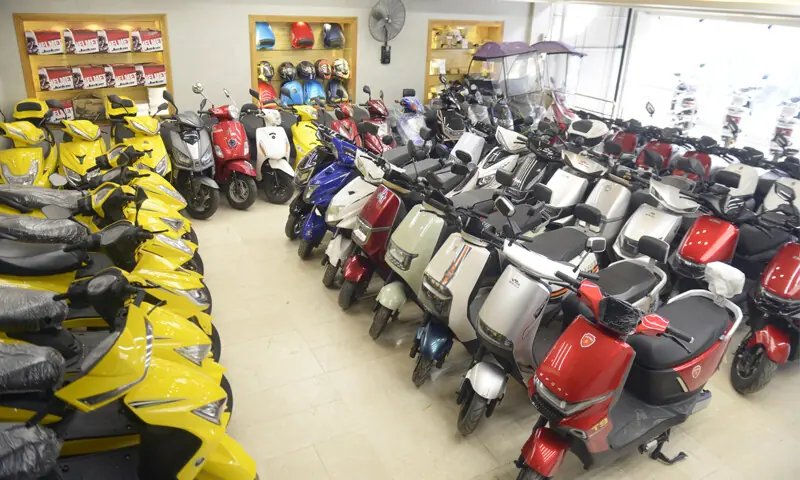
With petrol prices soaring, more. more people, especially from the middle class, have found electronic bikes to be a cheaper substitute for petrol-driven motorcycles.
The growing sale of e-bikes has also increased production. Locally manufactured e-bikes are available from Rs130,000 to Rs300,000 and are cheaper than many petrol-driven bikes.
Walking from Waris Khan Police Station to Banni Chowk on Circular Road. one can find shops selling e-bikes that were once hubs of petrol-driven motorcycles, where shopkeepers are now selling them briskly.
Junaid Abbasi, a motorbike owner, said that as petrol became more expensive, people shifted from regular motorcycles to e-bikes. He said the maintenance of e-bikes was easier compared to fuel-driven two-wheelers.
“Only 1.5 units of electricity are used to charge the bike, which is enough to drive 30 to 90 kilometres. Lithium batteries are fitted in most e-bikes and come with a five-year warranty,” he said.
He said the price of electronic scooties starts from Rs135,000 to Rs240,000, while e-bikes range from Rs150,000 to Rs300,000. He said most people now preferred e-bikes and the sale of regular petrol-driven motorcycles had declined.
Qari Khalid. president of the Motorcycle Association Circular Road, told Dawn that the sale of e-bikes had increased manyfold, with around 50 bikes being sold daily in the main bazaar.
He said most people bought e-bikes because they were easy to handle and required lower maintenance costs. “Usually, around Rs2,500 is spent monthly on petrol-driven motorcycles for motor oil changes. other maintenance, but there are almost no monthly maintenance charges for e-bikes.”
He said most people in the main motorcycle bazaars on Circular Road. Murree Road were replacing petrol-driven bikes with e-bikes. He added that both new. second-hand motorcycles were available in the market, but their prices and fuel expenses had increased.
Muhammad Shoaib, a resident of Committee Chowk, said petrol prices had increased manyfold. he had no option but to replace his petrol-powered bike with an electric bike, as he could not afford to spend Rs1,000 daily on fuel to commute to work.
He said the kitchen budget had increased significantly due to inflation. the daily cost of 2.5 litres of petrol, around Rs1,000, had added an extra burden. He said he had a limited salary, while fuel. food prices continued to rise without any increase in his income.
Mehwish Riaz, a university student, said e-bikes were the best option for women because they were easier to handle. cost less than fuel-driven bikes. She said she had learned to ride a motorbike. could now travel to university and the bazaar herself while saving money.
She said handling an e-bike was easier for her. other girls as there was no need to change motor oil every month and the bike only needed charging after 24 hours. She added that taxi cabs and buses were alternatives, but due to overcrowding, many girls avoided public transport.
Abdul Rehman, a student, said electronic bikes were better than normal motorcycles because conventional bikes consumed more fuel and, after the increase in petrol prices, spare parts such as motor oil, filters. other maintenance products had also become expensive.
However, some people complained that e-bikes had limited speed and were risky to use during the rainy season. They said rainwater often accumulated on roads in many areas and people feared damage to the electric system.
Muhammad Ayyan, a resident of Satellite Town, said e-bikes were suitable for single-person use. there were limited mechanics available in case of repairs.
However, he said there were plenty of mechanics for petrol-driven motorcycles. such bikes were more suitable for providing transport to small families. He added that the only major benefit of e-bikes was fuel savings.
Published in Dawn, May 18th, 2026
Discussion
Sign in to join the thread, react, and share images.