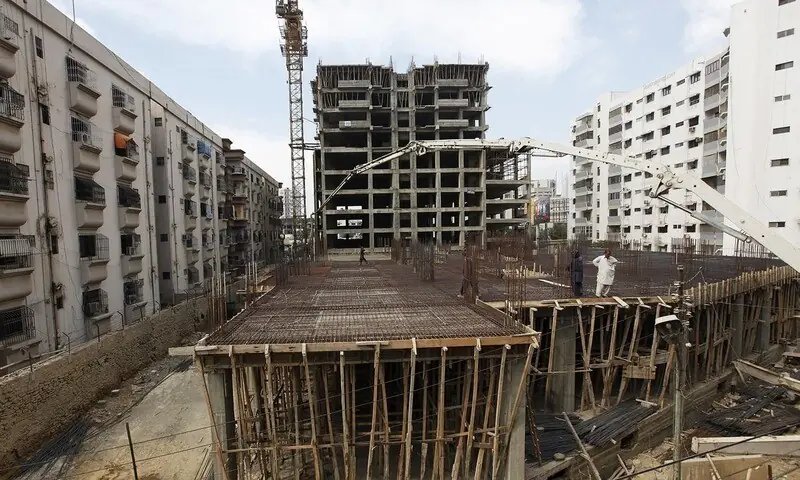
• Call to link commercial conversion of residential spaces with transparent master plan, meaningful public consultation. EIA• Barrister Usto says judiciary needs to be more aware of city’s urban, environmental issues
KARACHI: Residents, activists. legal experts on Wednesday raised alarm over the unchecked commercialisation of residential plots in Karachi, warning that the move would worsen traffic congestion, pollution, infrastructure collapse and environmental degradation across the metropolis, which is already plagued by multiple civic issues.
They were speaking at a press conference titled ‘Citizens Speak for a Liveable Karachi’. organised by the Karachi Citizens Foundation (KCF) at the Karachi Press Club.
It was pointed out that the city’s sewerage infrastructure is already collapsing under existing pressure. Even moderate rainfall overwhelms drainage systems, while unplanned development continues to merge sewage. stormwater systems, creating severe environmental and technical risks. In such conditions, allowing commercialisation in residential areas will make things worse.
Speaking on the occasion, KCF Convenor Nargis Rehman said Karachi had already been ranked among the world’s least liveable cities in the2025 EIU Global Liveability Indexdue to failing infrastructure, poor healthcare. education systems, insecurity and weak municipal services. “Karachi ranks at 170 out of the total 173 cities of the world in terms of liveability. The other three cities below Karachi are war-torn cities. That’s why they are there. But what war is going on in Karachi that it’s become so unliveable?” she asked.
She warned that further commercialisation without infrastructure upgrades, environmental safeguards. public consultation would place unbearable pressure on roads, sewerage systems and public utilities while increasing safety risks for residents, particularly women, children and elderly persons.
Barrister Shahab Usto said that the city’s planning crisis dated back decades, noting that the Karachi Development Authority Act was enacted in 1958. the city’s master plan was prepared around the same period, but no new comprehensive master plan had been implemented since then. He said Karachi’s population was around 1.8 million at the time, whereas it had now swelled to nearly 25m.
He said commercialisation in residential areas was generally allowed only under compelling circumstances in different parts of the world,. in Karachi it had expanded unchecked because of institutional dysfunction.
Moreover. Barrister Usto said around 500 million gallons of untreated sewage were being discharged into the sea every day as treatment plants were either non-functional or ineffective. He warned that marine life and mangrove forests were being destroyed due to pollution. He also highlighted Karachi’s worsening water crisis, saying the city was facing serious issues related to water supply. filter plants.
He said the judiciary needed to be more aware of Karachi’s urban. environmental issues, adding that the judicial system itself was also in a poor state.
Journalist. activist Shanaz Ramzi said homes meant for families are increasingly being converted into offices, clinics, restaurants, warehouses and commercial outlets, placing immense pressure on infrastructure that was never designed for such heavy use. “The resulting traffic congestion, parking chaos, noise pollution. increased waste are not only inconveniencing residents but are also eroding the peace, privacy and community life that define residential areas.”
Saad Amanullah Khan, chairman of the Public Interest Law Association of Pakistan, said that the issue is not merely one of land use or construction, but directly affects citizens’ right to live in safe, peaceful, planned,. liveable neighbourhoods.
The speakers unanimously demanded that residential neighbourhoods must be protected. Any change in land use must be accompanied by corresponding infrastructure upgrades, including roads, sewerage, drainage, parking, utilities. environmental safeguards.
Moreover, no commercial conversion within residential areas should proceed without a transparent master plan, meaningful public consultation, Environmental Impact Assessments (EIA),. compliance with the Sindh Environmental Protection Agency (Sepa) requirements.
Urban planner Mohammad Toheed, Zahid Farooq of the Urban Resource Centre and Rasha Tarek of the KCF also spoke.
Published in Dawn, May 21st, 2026
Discussion
Sign in to join the thread, react, and share images.