• Most town chairmen. particularly from opposition parties, say move will undermine democracy at grassroots level• Saeed Ghani says no discrimination made against any TMC
KARACHI: Despite longstanding complaints by towns over limited financial resources, the Sindh government’s recent decision to involve the Karachi Metropolitan Corporation (KMC) in executing Rs13 billion road rehabilitation. other infrastructure projects within their jurisdictions has raised the question of whether the arrangement is against the principle of devolution of powers and resources to the grassroots level of local government.
Officials. elected representatives in several towns, particularly those led by opposition parties, are questioning the rationale behind the arrangement under which development funds meant for municipal works will be controlled by the KMC rather than the towns themselves. The representatives argue that the policy risks rendering local councils ineffective. undermines the spirit of empowering the grassroots of democracy.
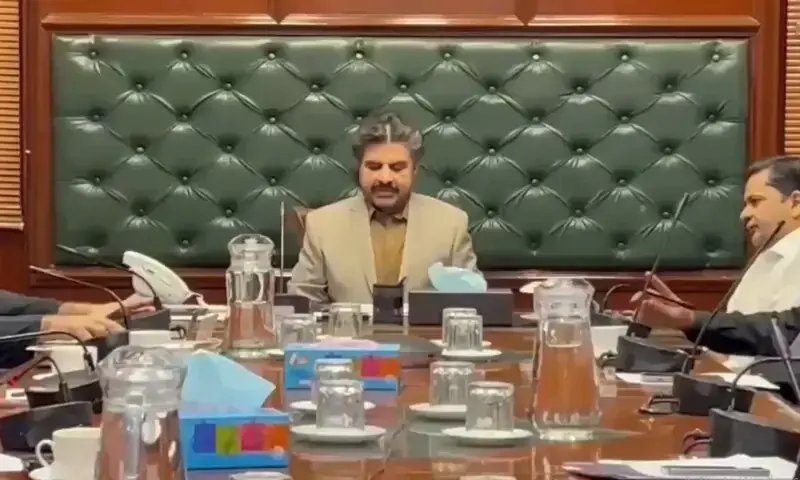
The decision to approve Rs13 billion for rehabilitation of roads across 24 town municipal corporations (TMCs) of the city came at a recent meeting of the cabinet sub-committee on finance. which was chaired by Sindh Minister for Local Government Syed Nasir Hussain Shah.
A statement issued after the meeting said that the committee approved major funding initiatives aimed at addressing Karachi’s longstanding urban challenges, particularly road rehabilitation, drainage,. sewerage infrastructure, with decisions involving allocations worth billions of rupees.
When asked about the reasons behind giving the executing agency mandate to the KMC for supervising development projects at the town level, Sindh Minister for Labour, Human Resources. Social Protection Departments Saeed Ghani, who had also attended the meeting, said that it was a consensus decision and had nothing to do with undermining the powers of the towns. “And if you look at the break up of these funding. you will find that most of the funds are allocated for towns in Central district of Karachi which is entirely governed by the opposition party [Jamaat-i-Islami],” he said.
“It is. in fact, a generous gesture on the part of the Sindh government that it decided to allocate funds from its own resources for development projects in towns. No discrimination has been made against any town in this regard. Moreover. it was not a new decision to hand over funds to the KMC; this understanding already existed when the towns were asked to submit proposals for their development projects.”
However, the towns mostly run by the opposition Jamaat-i-Islami, are against this argument.
They believe that true decentralisation can only be achieved by directly empowering local governments with financial and administrative authority.
They maintained that towns, being closer to the people, were better placed to identify. address the development needs of their respective areas.
Dr Fuad Ahmed, chairman of Gulshan-i-Iqbal Town, said that while the 18th Amendment to the Constitution is widely cited by the Pakistan Peoples Party as a landmark step towards devolution of power, the spirit of that framework demands that administrative authority. financial resources be transferred to the lowest tiers of government rather than concentrated at higher levels. He said the role of the provincial government should primarily be that of a facilitator. mediator, enabling towns and local councils to function in an empowered and effective manner.
“The genuine devolution requires direct financial empowerment of towns so they could develop institutional stability and public trust,” he said.
“The local governments should be provided funds and held accountable for how effectively they utilise them. The towns are in a much better position to understand needs and priorities of their own areas.”
Dr Ahmed believed that such an approach would also politically benefit the ruling PPP, as empowered towns could be judged transparently on their performance. delivery.
“Then the political point-scoring begins when development work carried out by the KMC is highlighted while towns are denied direct financial control. It is unfair to withhold funds from towns and then criticise them for not delivering,” he added.
The Pakistan Tehreek-i-Insaf chairman of Saddar Town, Mansoor Ahmed Shaikh, said that he does not object to the mandate given to the KMC for certain development projects in their towns but believes that the towns should not be practically excluded from the entire process. must remain actively involved in planning and implementation.
“At least towns should be given the mandate to monitoring and quality evaluation of these projects. Because at the end of the day. we will be the one held accountable for the work being done in our towns,” he added.
Almost similar concerns have also been raised by the Korangi Town chairman. PPP’s Muhammad Naeem Shaikh, who believes that all such development works should be subject to approval by towns before any payments are made.
“Payment for any development work in a town should only be released after a proper verification of the completed work on the ground. with the formal consent of the elected town administration, so that transparency is ensured and the town representatives, who are directly accountable to the people, are fully satisfied that the work has been carried out according to the agreed specifications and standards,” he demanded.
Published in Dawn, May 18th, 2026
Discussion
Sign in to join the thread, react, and share images.