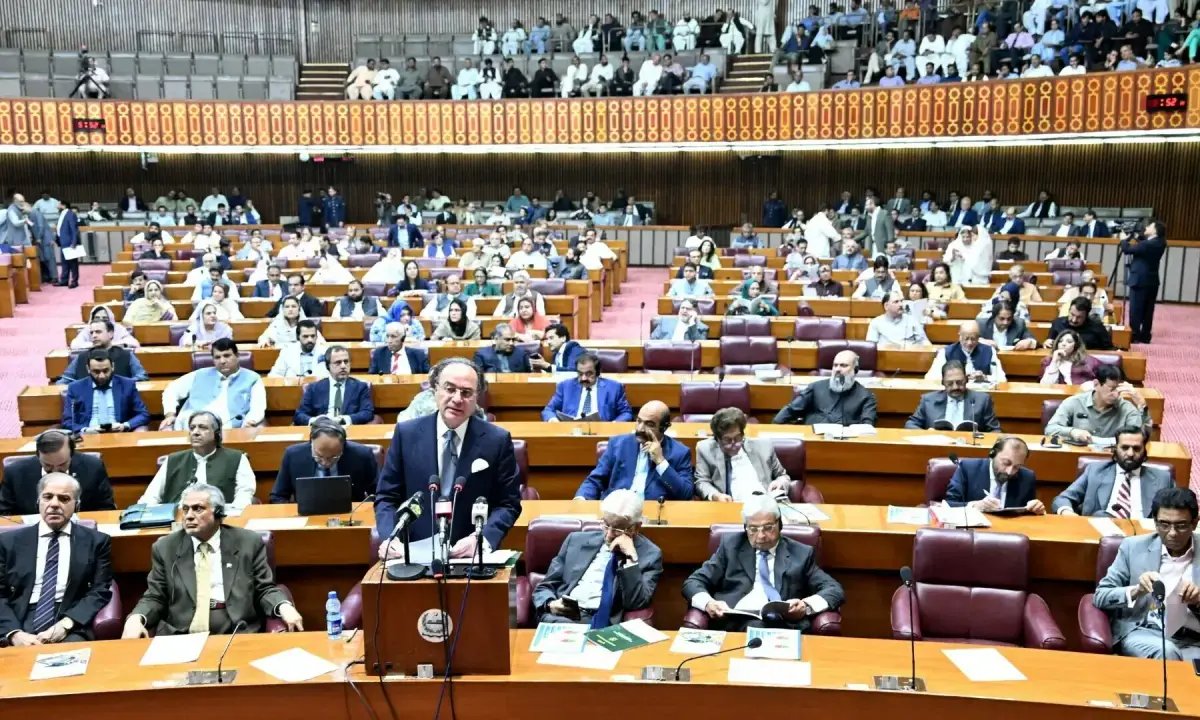
The federal budget for the upcoming fiscal year (FY26-27) is set to be presented in the upper. lower houses of the Parliament today.
Finance Minister Muhammad Aurangzeb was expected to present the financial plan in the National Assembly at 3pm,. the session has yet to begin.
In a post on X ahead of the NA session, Prime Minister Shehbaz Sharif said the budget has been prepared with “a lot of hard work. sincerity”.
He added that the “welfare and prosperity of Pakistan’s great nation has been given utmost priority”.
The premier also met with a delegation of the Muttahida Qaumi Movement-Pakistan (MQM-P). its coalition, where the two sides had discussions about the budget.
PM Shehbaz termed the MQM-P an “important allied party of the government”, hailing its “positive. constructive role in the development of the country, economic stability, and the completion of the agenda for public welfare”.
The coalition government is set to unveil fresh tax measures worth Rs660 billion to Rs700bn in the budget. according to aDawnreport.
In contrast to the broader revenue measures, the budget carries highly targeted good news for mid- and upper-level income earners.
Significant relief is planned for salaried individuals earning between Rs230,000. Rs341,000 a month in the upcoming budget, but a large segment of those making between Rs100,000 and Rs183,000 per month may not see any change, official sources said.
On Wednesday, Aurangzebsaidthe government would offer special incentives for agricultural productivity. the housing sector in the budget and provide end-user interest rates in single digits for 10 years.
He said a new taxation operating model for retailers. a “faceless” tax system — a digital and centralised system involving no contact between officials and taxpayers — would also be announced in the budget.
PM Shehbaz has said that the government wastaking measuresto bring the informal economy into the tax net.
The government last weekunveiledthe ‘Fixed Tax Asaan Scheme’ to bring small traders. shopkeepers into the tax net, with an annual turnover of up to Rs200 million.
It is reportedly alsoconsideringrelaxing the remittance cap in the upcoming budget, as overseas Pakistanis in several countries have complained of difficulties in protecting their investments. liquid assets abroad.
Until last week, the federal government, its coalition partners. provincial governments had beenstrugglingto reach a consensus over the Centre’s demand for more than Rs1 trillion for strategic needs.
However, the ruling PML-N. its major ally, the PPP, on Mondayreacheda broad agreement to cut development and other expenditures at all tiers of the federation and jointly create similar, but higher, fiscal space next year for additional “strategic needs”.
The freeze on provincial development programmes. expected to generate more than Rs900bn in additional resources for the Centre’s strategic needs, will continue for a specific period beyond one year,according tothe finance minister.
TheNational Economic Council(NEC), the highest economic decision-making forum of the federation, has set the federal. provincial development budget atRs3.218 trillionfor FY26-27.
It trimmed the federal and provincial uplift plans cleared by the Annual Plan Coordination Committee (APCC) by Rs1.046tr.
Punjab’s development plan was chopped by almost half. or 49pc, the biggest cut among all stakeholders, while Balochistan’s Rs308bn plan remained unaffected.
In the outgoing year, Pakistan’s economy grew by 3.7pc — almost the same as the 3.6pc reported at this stage last year, later revised down to 3.2pc — reflecting resilience. economic stability in the face of three major exogenous shocks: global trade and tariff challenges, floods in Pakistan and regional war-related pressures.
This was revealed in thePakistan Economic Survey 2025-26unveiledon Wednesday.
Aurangzeb noted that the economic recovery was broad-based this year, with 3.7pc growth — the highest in the last three years — supported by 2.89pc growth in agriculture, 3.5pc in industry. 4.09pc in services.
The economic report card also showed missed targets across major economic sectors in FY25-26. Except for services, all targets were missed.
The targets had been set at 4.2pc for GDP growth, 4.5pc for agriculture, 4.3pc for industry and 4pc for services. Large-scale manufacturing. Aurangzeb said, increased the most in the last four years to 6.1pc, while 16 out of 22 sectors showed positive trends.
The investment-to-GDP ratio came in at 14.38pc against a target of 14.7pc. while the national savings-to-GDP ratio stood at 14.13pc against a target of 14.3pc.
He said the size of the economy increased by 11pc to a record Rs126.87 trillion from Rs114.04tr last year, while per capita income improved to $1,901 in the outgoing fiscal year from $1,751 in FY25, reflecting improved economic activity. income growth.
Exports faced challenges and were down by 5pc, mainly because of a $1.5bn decline in rice and sugar exports.
Discussion
Sign in to join the thread, react, and share images.