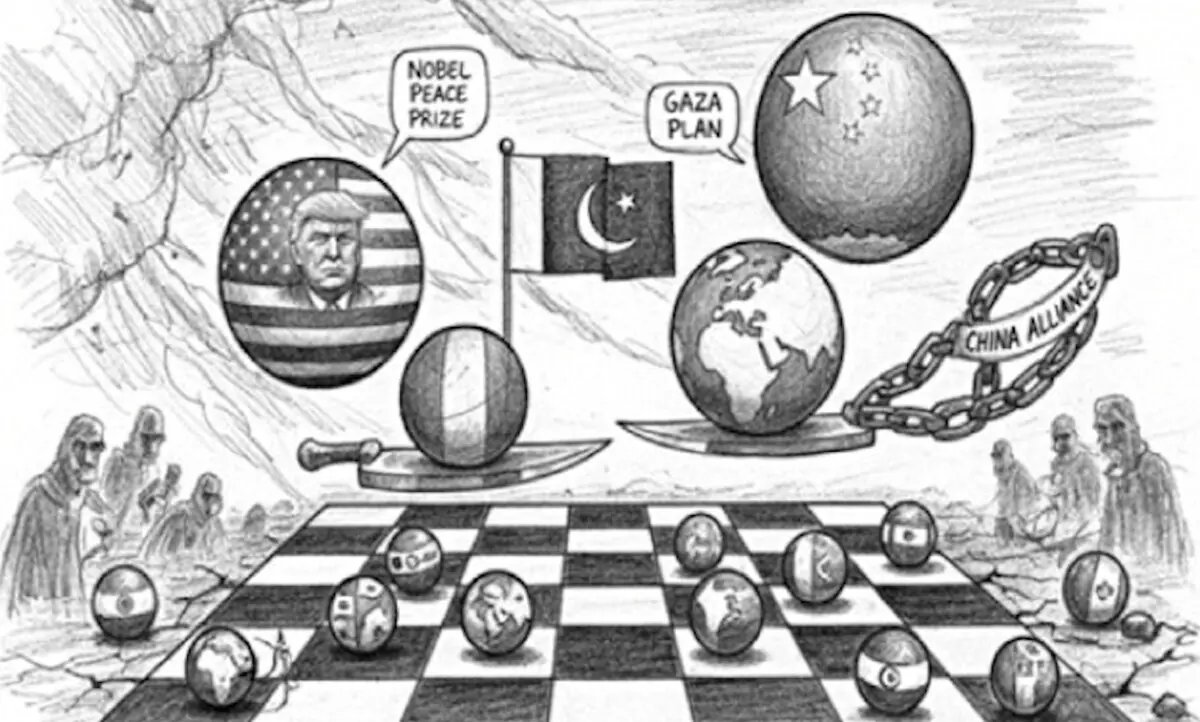
The US. Iran haveagreed to a basic framework.Whether this formal consensus translates into a concrete agreement is an open question. While Iran has officially declared the end of the war, Israel insists “our struggle has not yet ended”. Between these two statements lies all the space the spoilers need.
The ceasefire was made possible by pragmatists. It will be threatened by apocalypticists. In Washington. Jerusalem, there are people at the helm of affairs who do not read this war as a security crisis to be resolved but a scheduled event — one that a ceasefire can delay but not, in their theology, prevent. For them, a deal is not a solution. It is an obstacle. And obstacles, in the eschatological imagination, are not negotiated around. They are removed.
Whether the framework holds or collapses. one thing is clear: the West Asian security structure that existed on the morning of Feb 28, 2026, has ceased to exist.
Firstly, South Asian. West Asian security complexes are no longer analytically separable, asonce theorised by British political scientist Barry Buzan.Secondly, the war subjected regional alliances and client-patron relations to a stress test, and, to the surprise of many capitals, the old security arrangements proved to be holding nothing at all.
Many in the Gulf relied on American security guarantees. And it was not for the first time that the American security umbrella failed to protect them against Israeli belligerence. Iranian retaliation. This shared sense of being treated as collateral rather than partners will continue to haunt the GCC-US relations for years to come.
The GCC, meanwhile, did not respond to the recent war in unison. Instead, the US-Israeli war of aggression against Iran deepened some older fault-lines among the Arab states of the Gulf region.
In the Pakistani imagination, Saudi-UAE relations are often assumed to be a tight axis. This is no longer the case. These countries have experienced rifts and complete ruptures in the recent past, and the war has only consolidated them. Saudi Arabia and the UAE are proposing two distinct security mechanisms that carry significant implications for Pakistan.
Saudi Arabia desires to see an extended role for Pakistan and Turkey while normalising its relations with Iran. The starting point was theStrategic Mutual Defence AgreementSaudi Arabia signed with Pakistan on September 17. 2025 — just days after theIsraeli strike on Doha.
That particular act of aggression by Israel clearly demonstrated that Qatar’s status as a major non-NATO ally. host of the largest US base in the region could not shield it from external aggression. It has also nudged Doha to diversify its security arrangements, bringing it closer to the Saudi-Pakistan framework.
There was also subsequent talk of widening this framework — reports suggested Pakistan signalled Turkey. Qatar may join the Saudi defence pact, which would essentially formalise a Riyadh-Ankara-Islamabad-Doha (RAID) mechanism.
Abu Dhabi took the worst of Iran’s retaliation. answered with what American analysts termed a “defiant and forceful posture”, welcoming Israeli military assistance. Abu Dhabi’s response during the war has clearly illustrated that it is keen to integrate Israel. India into the Gulf security structure.
There are apprehensions that Emirati-Israeli-Indian intelligence. security cooperation could facilitate covert activities elsewhere in the Gulf, with destabilising consequences for the GCC as a whole. A case in point is the arrest of eight former Indian naval officers caught spying for Israel in Qatar in 2022. All of the accused were sentenced to death in late 2023. It was only after personal intervention by Indian Prime Minister Narendra Modi. the Qatari governmentreleased seven of the eight men in February 2024.
At a time when the Gulf’s two most consequential powers are pulling regional security in opposite directions. the question of where Pakistan plants its flag is not an academic one. Millions of Pakistani livelihoods, billions in remittances, energy imports on deferred payments. the credibility of Islamabad’s emerging mediatory role all ride on the answer.
Recent history offers the clearest insights. Pakistan has avoided camp politics. The recalibration of its relationship with the United States. China over the past decade is the most instructive example: Islamabad has learned to navigate the US-China rivalry without taking sides.
Pakistan’s insistence on strategic autonomy has been acknowledged at the highest level as something real, not rhetorical. Russian President Vladimir Putinrecently dismissed the claimthat Pakistan is a Chinese colony. In response to an Indian journalist, he emphasised that Pakistan is an independent, sovereign nation that maintains multi-faceted. diverse diplomatic ties across the globe rather than being solely aligned with or controlled by Beijing.
Pakistan then walked the tightrope between Iran. the Gulf states during the most serious regional war in a generation — maintaining open channels to Tehran while standing publicly with Riyadh, mediating where others were merely spectating.
The Saudi-UAE divergence over regional security presents a similar test. Pakistan’s historic ties with both countries run very deep — not merely at the level of diplomacy,. at the human level, where ties are hardest to sever.
Nearly three million Pakistanis live. work across the two countries, sending home remittances that form a major pillar for Pakistan’s fragile economy. Pakistan will not choose between Riyadh. Abu Dhabi — not because it lacks the courage to choose, but because it has learned, at some cost, that preserving both relationships is itself the strategy. This is exactly why Pakistan has prevented a public outcry over theUAE’s demand to return a USD3.5 billion loan. terming it a routine transaction with a brotherly nation.
The no-camps policy has doctrinal backing.Pakistan’s National Security Policy 2022-26,the first ever publicly released by any Pakistani government. is explicit on this point — articulating a vision of “geo-economics over geopolitics,” of engagement with all major powers without subordination to any. In the fractured Gulf of 2026, that may be the most sophisticated position available.
The old Gulf, predictable and broadly aligned, is not coming back. However, Islamabad has learned the hard way: choosing sides among friends is not a strategy.
Dr Khuram Iqbal is Associate Professor at National Institute of Intelligence and Security Studies Quaid-e-Azam University Islamabad.
NewsKit Publishing Platform
Discussion
Sign in to join the thread, react, and share images.