• CM says no new taxes announced for next fiscal year• Insists NFC entitlement protected under MoU• Province agrees to Rs260bn contribution for national strategic needs• Salaries. pensions raised by 7pc; minimum wage increased to Rs43,000• Development portfolio cut to Rs400bn; Karachi projects get Rs100.19bn• Red Line BRT gets Rs13.2bn, Yellow Line over Rs3.5bn
KARACHI: The Sindh government on Wednesdayunveileda tax-free Rs3.562 trillion budget for the fiscal year 2026-27, estimating total receipts at Rs3.525tr. showing a deficit of Rs36.9 billion.
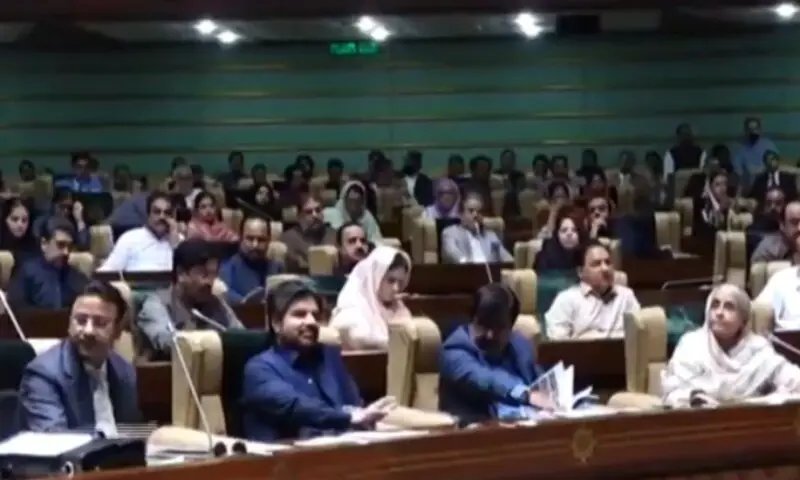
Presenting the budget in the Sindh Assembly, Chief Minister Murad Ali Shah, who also holds the finance portfolio, described it as a budget of hope, development. public trust and said the provincial government had tried to balance fiscal restraint with public welfare amid inflation, fuel-price pressures, global uncertainty and post-flood reconstruction needs.
The chief minister said the provincial government had been compelled to slash its development portfolio from a projected Rs575bn to Rs400bn after contributing towards national strategic requirements under a negotiated arrangement with the federal government.
“Even in a difficult fiscal environment, we have protected priority development projects. essential public services that directly affect the lives of our people,” he said.
CM Murad said the arrangement with the Centre was backed by a memorandum of understanding. fully protected Sindh’s constitutional entitlement under the 7th NFC Award through a guaranteed federal revenue assignment base of Rs13.350tr.
He added. any national requirements beyond the agreed Rs260bn would be met by the federal government from its own resources. “Our approach was guided by a simple principle: fiscal prudence must enable development, not constrain it,” he said.
Major ADP allocations include Rs121.66bn for local government, mega, water. sanitation and roads-related schemes; Rs40.86bn for public health engineering and rural development; Rs39.54bn for transport and communication; Rs30.94bn for irrigation; Rs25.86bn for education; Rs17.43bn for health; and Rs6.3bn for agriculture, including livestock.
On the revenue side, Sindh has projected provincial own receipts of Rs775.06bn, including Rs690.06bn in provincial tax revenue. Rs85bn in non-tax revenue. Sales tax on services remains the largest provincial revenue source and is estimated at Rs450bn for the next fiscal year.
Announcing that there would be no new taxes in the coming fiscal year, CM unveiled a series of relief measures aimed at supporting education, agriculture, insurance. employment sectors.
The chief minister announced a 7pc increase in salaries. pensions with effect from July, saying the raise came by amalgamating the ad hoc relief allowances of 2022 and 2025 into basic pay. He said the minimum wage had also been increased from Rs40,000 to Rs43,000 per month.
The sales tax rate on education support services is proposed to be reduced to 5pc. while the reduced 5pc rate on recruiting agent services for overseas employment is proposed to continue for two more years.
The government also plans to reduce tax rates for insurance agents. brokers and raise the exemption threshold for agriculture income super tax from Rs150m to Rs500m, while reducing the rate from 10pc to 8pc.
For social support, the government has earmarked Rs13.3bn under the pro-poor portfolio. The portfolio includes the Sindh Peoples Support Programme, Benazir Hari Card, Benazir Housing initiatives, kitchen gardening kits for poor. landless farmers, livestock distribution, support for persons with disabilities, SME financing through the Sindh Enterprise Development Fund, women agricultural workers’ support, capacity-building schemes and assistance for widows and orphans.
The budget also continues support for flood recovery and housing reconstruction. The government said foreign financing had been mobilised for the housing programme. that over one million houses had been completed, while more than 1.6m housing units had entered the construction phase.
Karachi-related allocations and initiatives include support for major water, roads, transport and municipal infrastructure projects.
CM Murad said Karachi remained the province’s economic engine and had been accorded special priority. He said the city’s development portfolio comprised 816 schemes with an overall cost of Rs644.3bn.
The chief minister said Rs100.19bn had been earmarked for Karachi-based projects.
He said transport allocations included a Rs1.2bn flyover from Airport Road to Star Gate, a Rs1.5bn right-turn underpass from Malir Halt to Shahrah-i-Faisal,. a Rs1.65bn flyover at Sir Shah Suleman Road over Gujjar Nullah.
Funds have also been allocated for the Shahrah-i-Bhutto-Korangi Causeway junction and Malir Expressway interchanges.
The budget documents refer to funding for the Dumlottee-to-DHA pipeline, K-IV energy requirements, FWO-executed road. bridge projects, KDA infrastructure improvement, KMC projects and CLICK-supported municipal reforms across town municipal corporations.
In public transport, the government highlighted the expansion of the People’s Bus Service, induction of electric minibuses. double-decker buses, planned addition of more electric buses and procurement of 500 electric buses under the broader green transport programme.
CM Murad said the government had also allocated Rs13.2bn for Red Line BRT and over Rs3.5bn for Yellow Line BRT.
The chief minister said the government would focus on completing ongoing schemes, protecting essential public services. maintaining support for health, education, social protection, agriculture, transport and urban infrastructure despite fiscal pressures.
Published in Dawn, June 18th, 2026
Discussion
Sign in to join the thread, react, and share images.