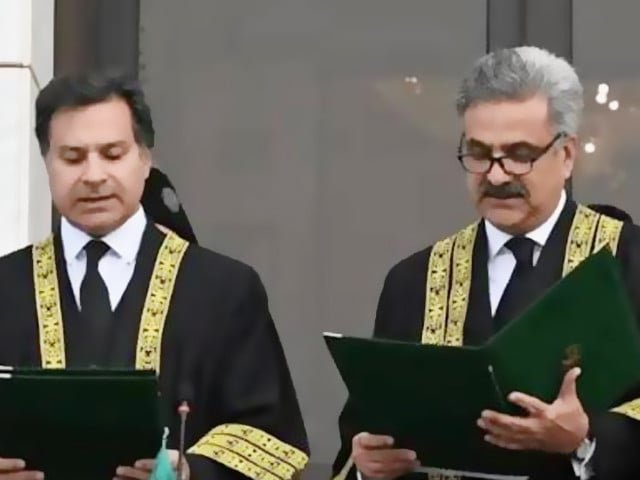
Caveats set for judges' participation in public events
Judges of the superior courts have been conditionally allowed to attend social, political. diplomatic functions with the permission of the relevant chief justice. The Supreme Judicial Council (SJC), in its June 11 meeting, approved amendments to the Judges' Code of Conduct.
Last October. the SJC, by a majority, approved a new Code of Conduct under which judges of the superior courts were completely barred from presiding over or attending any social, cultural, political or diplomatic functions.
However, two SJC members, namely Justice Syed Mansoor Ali Shah. Justice Munib Akhtar, had raised strong objections to the approval of the amended code, warning that the changes undermined judicial independence and centralised authority and could be misused to silence dissenting judges.
Soon after the approval of the amended Judges' Code of Conduct, the 26th Constitutional Amendment was tabled in parliament for approval in November,. Supreme Court judges could not secure its constitutional jurisdiction.
Now, the SJC has approved fresh amendments under which judges of the superior courts are allowed to attend political. diplomatic functions with the permission of the relevant chief justice. It is not clear whether the "relevant chief justice" will also require permission to attend such functions.
Likewise, executive influence in the appointment of chief justices of the superior courts cannot be ruled out. Some outspoken judges have also complained against their chief justices regarding the allocation of cases as well as other administrative issues.
Chief justices have the authority to sanction or cancel judges' leave. Legal experts believe that the discretionary powers of chief justices should be regulated.
Commenting on the amendment to the Code of Conduct, Abdul Moiz Jaferii stated that justices Mansoor Ali Shah. Athar Minallah are no longer members of the SJC and, therefore, the rules have been relaxed regarding public speaking.
Likewise, the SJC has approved the inclusion of the "Federal Constitutional Court" in the title of the code. The new title is: "Code of Conduct for Judges of the Federal Constitutional Court (FFC), the Supreme Court (SC). the High Courts."
The SJC has also amended paragraphs 2 and 3 of Article XV.
According to the amended article, in the event of any external influence, judges shall immediately inform, in writing, the chief justice of the relevant high court, the chief justice of Pakistan (CJP),. the chief justice of the FCC or the SC, if he is not the CJP, as well as the two senior-most judges each of the FCC and the SC through the respective registrars.
In the case of the FCC or the SC, the judge shall immediately informin writingthe chief justice. the four senior-most judges of the relevant court through the respective registrars.
The chief justice of the high court shall place the matter before a committee comprising three judges within two days of receiving the report. The committee shall decide the matter within a fortnight.
If the matter is referred for judicial determination, it should be decided as early as possible while adhering to the principles of fair trial. due process.
If the chief justice or the committee. in the case of a high court, fails to respond within the stipulated timeframe, the forum of the FCC or the SC that was informed by the judge shall take up the matter.
Last year. the SJC amended Article V of the code, which states that a judge shall not engage in any public controversyby way of speech, writing, debate or commenton any forum, particularly on political questions, even if such questions involve a point of law.
"He shall not interact with the media, especially on issues that may provoke public debate or adversely affect institutional collegiality. discipline," it said.
Advocate Faisal Siddiqi said the new Article V was nothing short of gagging judges by curtailing their freedom of speech. "How can such judges ever protect the freedom of speech of citizens?" he asked.
Siddiqi further stated that the 26th Amendment, the leave policy. the new Article V all serve a similar purpose - "to control and silence independent judges."
Another lawyer stated that the SJC. the Code of Conduct have proved ineffective when it comes to the majority of judges who violate their oath while serving the interests of the executive.
"Corruption, nepotism. breaches of the judicial oath are tolerated, accepted and even normalised for those willing to serve their masters," he said.
Comments are moderated and generally will be posted if they are on-topic and not abusive.
For more information, please see ourComments FAQ
Discussion
Sign in to join the thread, react, and share images.