HYDERABAD: Rows of acacia and mango trees lined the route. Koel birds’ constant cooing added to the serenity of the area. Surrounded by agricultural landscape. a colonial era spacious palace stands behind thick neem trees in Tando Mir Noor Mohammad Talpur — a village where descendants of Sindh’s Talpur rulers had arrived after being released by the British Raj from India in the wake of the conquest of Sindh.
An over 160-year-old structure, the palace is preserved by the Mirs’ fifth generation. No major changes are made. Tando Mir Noor Mohammad is named after the son of Bibi Sona Talpur. daughter of Mir Naseer Talpur, the last Talpur ruler dethroned by the British Empire.
His men were defeated in Feb-March 1843 by Charles Napier’s army on the outskirts of today’s Hyderabad city in battles of Miani. Dubbo. She was married to her paternal cousin Mir Hussain Ali Talpur, son of Mir Noor Mohammad.
Tando is a Sindhi word that defines gated settlement. named after by some notable, which were to later emerge as cities or towns. After defeating their predecessors — the Kalhoros — Talpurs governed Sindh from Hyderabad’s Pucca Qilla. The fort was their principal seat of rule with separate administrative machineries headquartered in Khairpur and Mirpurkhas. Another definition explains Tando as a jagir given by Talpurs to their advisers, ministers and loyalists.
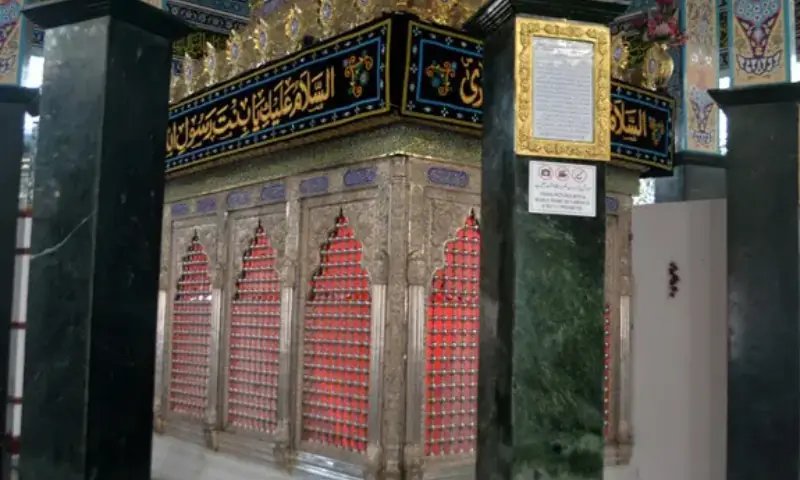
A zari resembling Sayyida Zainab’s shrine in Damascus has been built in Tando Mir Noor Mohammad as a mark of their unconditional love
Tando Mir Noor Mohammad is located near the left bank of the Indus river downstream Kotri barrage. The area is now part of present day unit number-4 Latifabad — a satellite town. emerged in post-partition period in Sindh. Quite a few tandos — Tando Mir Ghulam Hussain, Tando Thoro, Tando Yusuf, Tando Mir Mehmood, Tando Wali Mohammad. Tando Agha Ismail Shah commonly known as Tando Agha, etc, are thickly populated areas which form part of this historic city, Hyderabad.
The last Talpur ruler. Mir Naseer Talpur was buried in the graveyard of Hirabad — known as Miran ja kubba — after he died in Damdama, India in 1845 during incarceration. Interned Talpurs, after being freed by the Britishers, upon reaching Sindh didn’t settle in their erstwhile throne — Pucca Qilla.
“The palace was built by Mir Hassan Talpur in 1865 after he was released in 1863 and relocated here. Mir Hussain Ali arrived in Sindh in 1858. Our elders were given 223-acres of land by the colonial regime for residential purposes,” recalled Mir Haider Talpur while speaking to Dawn in a spacious room of the palace where portraits of Talpurs were hung on four walls.
“After the conquest, eleven of our elders were shifted to India where seven died in captivity,” Haider said.
He is the oldest living descendant of Mir Noor Mohammad Talpur, son of Bibi Sona Talpur. Four survivors were her husband. cousin Mir Hussain Ali, her brother Mir Hassan Ali, Mir Yar Mohammad and Mir Mohammad Khan. Bibi was daughter of one Talpur ruler and daughter-in-law of another.
A vast area in today’s Latifabad was owned by the Talpurs. This Tando’s dynamics, over the years, have changed ever-since settlement of migrated population from India after the subcontinent’s partition. The Talpurs from time to time, on the other hand, have sold their lands to real estate developers. Such sales are still continuing. “The palace and its agricultural land stretch over 10-acres,” revealed Haider.
Whilst the Tando’s demography has rapidly changed, the Talpurs’ tradition of showing reverence for Ahl-i-Bait is intact. It is where the surviving Talpurs. their kith and kin continued their elders’ legacy — azadari, tazia and alam — after they lost Sindh.
Mir Hassan Talpur at. time got a tazia — a replica of the mausoleum of Imam Husain — built to express his love for the Holy Prophet’s (PBUH) grandson in the Tando. It is as old as the settlement itself.
Hyderabad witnesses some oldest pirs in Muharram. Pir is a spot where mourners gather for mourning around an alam. Such pirs were named after different men. These ‘pirs’ are mentioned in the PhD thesis ‘Sindhi ji tareekh: Miran. Talparan ja daur” by Dr Qamar Jahan Mirza, published by Pakistan Study Centre of Sindh University. “Around 18 pirs in Hyderabad dating back to Chauyari [rule of four friends] of Talpur era are mentioned in thesis”. said Naseer Mirza, a literary figure of Hyderabad.
The Sindhi term, Chauyari, denotes collective rule under the Talpur dynasty comprising Mir Fateh Talpur, Mir Ghulam Ali Talpur, Mir Karam Ali Talpur. Mir Murad Ali Talpur.
The Mirs’ present generation hasn’t lagged behind in emulating their elders, either.
A zari resembling Sayyida Zainab’s shrine in Damascus. Syria has been lately built in Tando Mir Noor Mohammad by Haider’s younger brother Mir Mohsin, a retired government employee as a piece of exquisite workmanship is an addition to keep Talpurs’ legacy alive.
Zari. a Persian word for grave of some spiritual or sacred personality of highest order, is a square shape enclosure often made of wood like the one at Qalandar Lal Shahbaz’s shrine in Sehwan. The actual tomb (here a replica) like any shrine elsewhere lies inside zari.
This one of Sayyida Zainab’s has entailed a substantial cost. Mohsin avoided mentioning it as a mark of their family’s unconditional love for these sacred personalities. Its inner sanctums look beautiful with the use of marble stones, paintings. Silver colour zari with latticework was procured from Iran.
On the outer side, its façade having six arches with a golden dome looks like an actual mausoleum. A smaller dome engraved with paintings. Quranic verses is built inside with use of big and small chandeliers to make it fascinating and surrounded by multiple long columns around zari. Mir Hassan’s tazia is kept in the same precincts. It has been improved from time to time for conservation needs.
The lone minaret of zari is still under construction. Kals — made of pipe or wood where rests a human palm attributed to Hazrat Ghazi Abbas. is known as such as last component of alam — is to be fixed on dome and minaret.
“Zari was brought last year from Iran via Gwadar by road. Its parts were assembled by Iranian workers in imambargah” Mohsin tells Dawn. The workers stayed there for 10 days to finish the job. “Only restricted entry is given to people now,” said Mohsin.
Trend of designing zari or replicas of mausoleums of the fourth caliph. Hazrat Ali, his son Imam Husain, or Imam Raza has become popular lately. Another zari replicating Maula Ghazi Abbas, brother of Imam Husain, was designed by Imamia Trust management in Latifabad sometime back. 1965’s imambargah of Tando Thoro was designed on the pattern of Iranian architecture, resembling Imam Raza’s mausoleum.
Premier quality wood is preferred choice in a zari depending on availability of wood like sagwan or other variety. “Even imagining the mausoleum of such personality ensures exaltation. elevation for a faithful,” believed a poet, Salamat Feroz Shaikh, who writes mersias which were often recited by iconic Rahat Fateh Ali Khan.
“The Mirs’ love for Ahl-e-Bait is well known,” observed Naseer, a former station director of Radio Pakistan, Hyderabad. “The Talpurs come from the Jafri branch of Shia Muslims,” he said.
The Talpurs didn’t stay in Pucca Qilla. Mir Hassan Talpur believed he won’t be able to bear the pain of reminiscing about their past. that’s why he called for relocation at a place near the Indus river,” he added. According to him, The Mirs were literary men. “Mir Naseer wrote Deewan-e-Jafri to pay literary tribute to Imam Husain and his family members,” he said.
Published in Dawn, June 25th, 2026
Discussion
Sign in to join the thread, react, and share images.