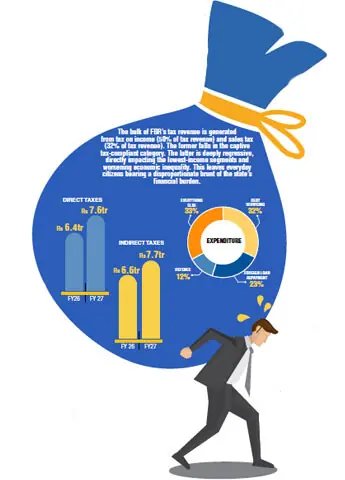
The budget serves as a reminder that the vast majority of Pakistanis in the middle of the social spectrum will continue to bear the cost of government missteps. the inefficiencies of inadequate physical and social infrastructure providers, in addition to the fallout of the volatile global situation and tensions with Afghanistan. In the fiscal year ahead, their relentless struggle to make ends meet. to provide a decent life for their families will remain all-consuming.
The proposed budget offers the salaried class a modest three to five per cent reduction in tax liability. applicable only for those earning at least three times the taxable monthly income threshold of Rs50,000. While the relief may be meaningful for its beneficiaries, excluding poor. lower-middle-class taxpayers, who arguably need support even more, is difficult to justify.
Unless policymakers attach value to retaining a larger number of lower-income taxpayers in the tax net. the rationale of this exclusion remains unclear.
Pakistan’s income tax compliance remains dismally low. A wide gap persists between the number of registered taxpayers and those who actually pay taxes. By some estimates, fewer than 5pc of adults in Pakistan pay income tax. Enforcing compliance is challenging in a cash-dominated economy with a vast informal sector and limited documentation.
Modest tax cuts offer limited comfort as inflation, fuel costs and economic uncertainty continue to squeeze middle- and lower-income households
In contrast, salaried employees are effectively captive taxpayers because their taxes are deducted at source. Meanwhile, successive governments have been reluctant to aggressively pursue powerful tax-averse groups, such as large farm owners, realtors. traders, fearing political backlash.
The war in the Gulf has pushed up oil prices. freight costs, raising the cost of trade, travel and transportation. It also threatens to disrupt supply chains. Meanwhile, the closure of Torkham. Chaman border crossings has hurt cross-border trade and adversely affected the livelihoods of communities that depend on border-related economic activities.
“Raising the taxable income threshold would have shrunk already narrow tax base. Without credible measures to offset the revenue loss. a fall in the number of tax filers from exempting lower-income salaried workers, the government considered the move too risky, particularly given the International Monetary Fund’s (IMF) sensitivity to any erosion of the tax base.
“The failure of last year’s Tajir Dost Scheme also undermined the confidence in the fixed-tax regime for traders introduced in the current budget. reinforcing the decision to leave the taxable income threshold unchanged,” an analyst said.
“Yes, it may seem unfair, but the government appears more concerned about satisfying its core supporters and the IMF. By refraining from raising the general sales tax [GST], increasing salary. pensions for public-sector employees, allocating additional funds to Benazir Income Support Programme, and lowering tax rates for taxpayers in the upper-income brackets, it likely believes it has done enough to provide relief,” an economist remarked.
Dr Rashid Amjad, former deputy chairman of the Pakistan Institute of Development Economics (BISP), was sceptical. He argued that the budget had effectively been negotiated with the IMF before its presentation. leaving little room for independent policymaking.
He questioned the government’s claim of shifting from stabilisation to growth, arguing that a cut in development spending would dampen growth while aggravating unemployment. poverty.
While welcoming the increase in the minimum wage, public sector salaries. pensions, and BISP allocations, he said these measures would offer limited relief in an environment of expected double-digit inflation and high petroleum levy. “The tax cuts for the middle class are more window dressing than meaningful relief,” he remarked. “All in all, it is a budget that tries to please everyone. ends up pleasing hardly anyone except the IMF”, he added.
The proposed budget lowers income tax rates for three upper-salaried income brackets, leaving the income threshold. tax rates on the two lowest income slabs unchanged. The rate for monthly incomes between Rs1,83,000. Rs2,66,000 has been reduced to 20 per cent from 23pc; for incomes above Rs2,66,000 and up to Rs3,41,000 per month, it has been cut to 25pc from earlier 30pc; and for those earning Rs3,41,000 and Rs4,67,000 a month, the rate has been lowered to 32pc from 35pc. The annual surcharge on high-salaried individuals has also been abolished. Previously, a 9pc surcharge applied to income earners with a monthly salary exceeding Rs8,33,000.
Over the next financial year, low-salaried households are likely to further tighten their budgets to cope with rising inflation. high fuel costs. Many families may be compelled to supplement incomes by working longer hours or pushing more household members into the workforce. As spending on food, transport. utilities consumes a larger share of earnings, less will remain for housing, rent, education, healthcare and leisure. For many, saving will become impossible, forcing them to draw down assets to maintain basic living standards.
“Confronted with serious economic challenges amid a highly volatile global environment. any government would have struggled to balance fiscal responsibility with socio-economic goals while building public support. The task is even more daunting for Prime Minister Shehbaz Sharif’s coalition government, which must navigate the demands of political allies, powerful lobbies. stringent donors, leaving little room for manoeuvre.
“Within these constraints, delivering meaningful relief to the roughly 80 per cent of households that fall between the affluent. the poorest segments remains a formidable challenge. His team did try to make the budget people-friendly,” a supporter defended the government.
Beyond the routine political rhetoric condemning the government’s performance. its failure to match public expectations, most Pakistanis assess the federal budget primarily through its impact on their household finances. According to unverified online estimates, around 15-20 per cent of the population, including taxpayers, professionals, politically engaged citizens, analysts, media personnel. members of the business community, closely follow the annual budget process, tracking fiscal priorities, taxation measures and policy changes that shape the economic outlook.
Some analysts consider these estimates overly optimistic. “I would be pleasantly surprised if even five per cent of Pakistanis could meaningfully decipher the budget,” remarked one observer. “For most people, it appears to be little more than a juggling of numbers and a politically motivated accounting exercise. This perception persists largely because there is neither a serious effort within the power corridors to generate. utilise credible data to identify weaknesses in the framework, nor a genuine commitment to reforming it to make it people-centric and responsive to the interests of the majority.”
Others attribute the public’s limited interest. engagement in what is arguably the most important exercise in the country’s annual financial cycle to the government’s own conduct. “To conceal the cost of its inefficiencies. mask policies that disproportionately favour elite segments, budget makers deliberately make the process and its contents complex,” observed a retired civil servant.
Published in Dawn, The Business and Finance Weekly, June 15th, 2026
Discussion
Sign in to join the thread, react, and share images.