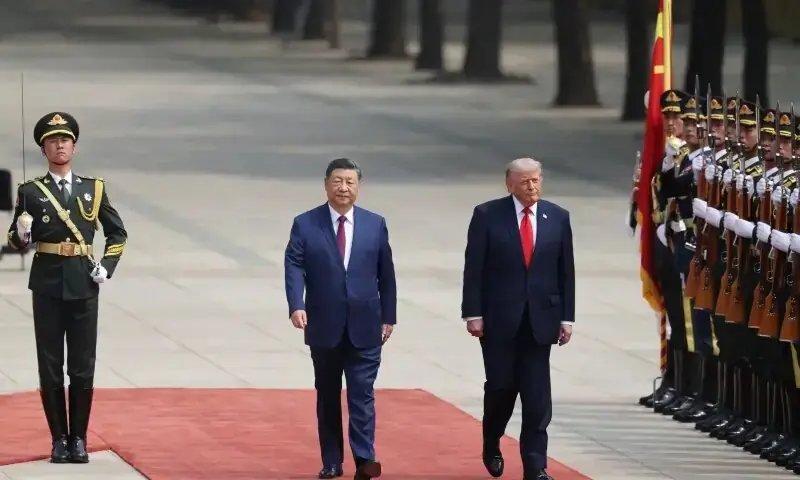
PresidentDonald Trump’s visit to Beijing this weekmay have produced modest results by the standards of US-China summits but it highlighted a clear benefit for China: after the extremes of last year’s trade war, the countries have reverted to their familiar economic. strategic standoff.
Two days of talks between Trump. Chinese leader Xi Jinping underscored that even after Trump’s “Liberation Day” tariffs and the ensuing trade detente the two sides reached late last year, Washington and Beijing are still locked in the contest that Trump inherited when he started his second term.
For the United States. that means that the most troubling aspects of the relationship — from what it considers Beijing’s mercantilist trade policies to its efforts to increase its military clout in the Indo-Pacific — remain largely unaddressed.
But for Xi it offers some breathing room and a return to a more predictable set of challenges. He appeared to describe the change this week with a new framework for the countries’ relations he called “constructive strategic stability.”
China came out ahead, given the retreat from the Trump administration’s brash approach on trade from early 2025, said Scott Kennedy, a China expert at Washington’s Center for Strategic. International Studies.
“Compared to where we were a year ago, with 145pc tariffs. the US really trying to push China and the rest of the world to fundamentally change, we’ve had a counterrevolution and we’re back at stability,” Kennedy said.
Trump brought to the Thursday-Friday summit some of America’s most powerful executives, from Tesla’s Elon Musk to Nvidia’s Jensen Huang,. most had little to show for their time, aside from a lavish banquet.
The meeting also did not secure any public commitment from China to help the US end the war in Iran that has roiled global markets. dented Trump’s approval ratings.
“The summit projected stability. it left the stalemate intact,” said Craig Singleton, a China expert at the Foundation for Defense of Democracies.
It “produced modest, marketable and managed outcomes, which is about all the US-China relationship can bear right now.”
Asked for comment, a White House official said, “President Trump leveraged his positive relationship with President Xi of China in order to bring home deliverables for the American people,” citing the sale of Boeing aircraft. agricultural agreements to expand American exports.
A spokesperson with the Chinese embassy in Washington called the meetings between Xi. Trump “candid, in-depth, constructive andstrategic,” adding that they “explored the right way for two major countries to get along with each other.”
With last year’s trade war. Trump appears to have overestimated the power of tariffs to coerce China into unilateral concessions, analysts say. Beijing retaliated with its own tariff hikes. threatened to choke off supplies of critical minerals needed by US industries, forcing an uneasy standoff.
Since then, the White House has shown itself unwilling to bear the economic consequences that would come with applying the other forms of US financial. technological leverage, such as sanctions on China’s major banks.
Reflecting the change in tone. there was no public mention this week of many long-standing US demands, such as for China to address industrial overcapacity that its trade partners say unfairly floods their markets with low-cost goods.
China appears content with the fragile truce as it navigates a weak domestic economy. seeks to shore up technologies it hopes will turn the tide in long-term competition with the US.
Senior Trump administration officials had downplayed a desire for big outcomes even in the run-up to the meeting. saying there was no rush to extend a trade truce, expiring in five months, which the leaders reached after talks in South Korea in October.
‘Below Expectations’
A person familiar with the trade negotiations said China wanted a longer extension of the truce than the Trump administration was willing to give. as well as reassurances over pending US investigations likely to revive some tariffs on goods entering the US that were struck down by the Supreme Court this year.
Overall. neither side put much on the table for the summit, the source told Reuters, adding that some commercial deals could be saved for the fall, when Xi is expected to make a reciprocal visit to the White House.
The source requested anonymity to speak candidly about the negotiations.
The summit’s thin commercial results contrast with Trump’s 2017 visit to China, when companies accompanying him signed deals. memorandums of understanding valued at $250 billion.
This week’s meeting produced no breakthrough on selling Nvidia’s advanced H200 artificial intelligence chips to China, likely to the relief of Republican. Democratic China hawks in Washington, who had warned the administration against feeding China’s AI development.
Though still not confirmed, Trump said Boeing had sealed a deal for China to purchase 200 jets, well below the 500 anticipated. the 300 Beijing agreed to purchase during the 2017 visit.
The White House official said the US had established a new Board of Trade that US officials had mentioned as a joint mechanism to lower tariffs on non-sensitive goods,. offered few details.
Wendy Cutler. a former acting deputy US Trade Representative, called the economic deliverables “way below expectations.” For China, however, the meetings were a positive move toward clear-eyed competition, said Cui Shoujun, a professor of international affairs at Renmin University in Beijing.
The summit showed that Washington. Beijing are “no longer aspiring to pull China-US relations back to a cooperative golden age, but instead acknowledging the long-term nature of competition and disagreement,” he said.
Discussion
Sign in to join the thread, react, and share images.