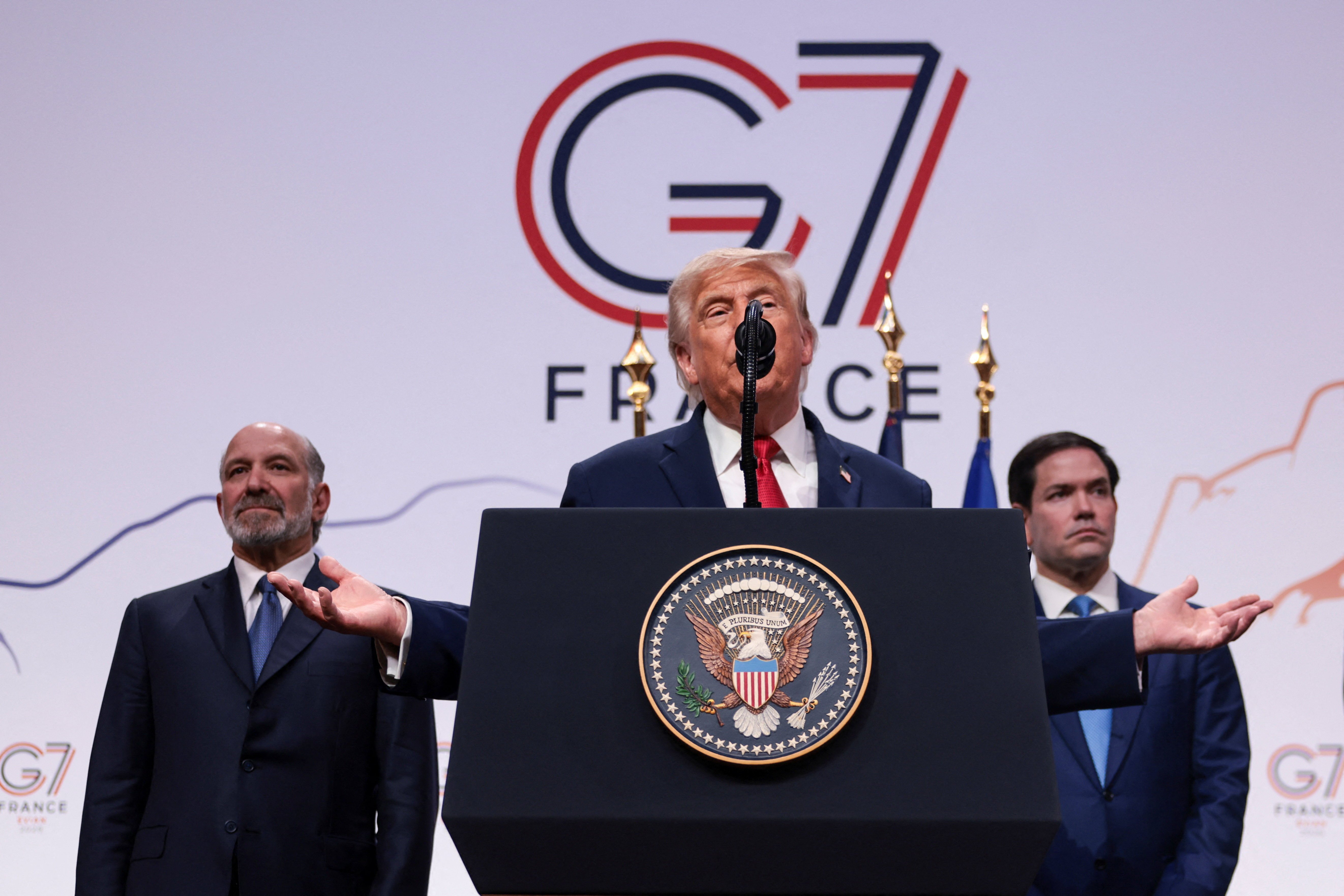
Defends US-Iran deal, says he does not want an economic catastrophe triggered by continued Middle East war
US President Donald Trump on Wednesday said he expected the accord with Iran ending the Middle East war to be signed "shortly". added uncertainty over the exact date.
"The deal we reached with Iran on Sunday will be signed shortly. tomorrow (Thursday), maybe the next day (Friday)," Trump said at the G7 summit, after previous announcements that it would be signed Friday in Switzerland.
"We are going to most likely sign a deal," he added.
Trump told reporters at the final press conference of the G7. he was prepared to "bomb the hell" out of Iran if they violated the agreement.
"If they are not behaving they will be hit again," he said.
But he added: "They don't want to get bombed, they don't want to get hit".
In a long succession of comments on his dealings with Iran. Trump recalled at length how he had in 2020 issued the order to kill Qassem Soleimani, the head of foreign operations for the Revolutionary Guards, who he described repeatedly as a "mad genius".
Trump also recalled the February 28 air strike that killed supreme leader Ayatollah Ali Khamenei. other senior figures, who he said were "having breakfast" at the time.
Trump was also asked about the deadly strike on an Iranian school in Minab on the first day of the war. which left 155 dead, according to the Iranian authorities.
Initially describing the question as "strange", Trump said: "Nobody did it on purpose. Mistakes are made, war is nasty."
"I know it is under investigation," he said. telling the reporter to address the question to Defence Secretary Pete Hegseth instead.
A US Tomahawk cruise missile hit the elementary school due to a targeting mistake. according to the preliminary findings of a US military investigation reported by The New York Times.
Trump also thanked Russian President Vladimir Putin and Chinese President Xi Jinping for staying "neutral" in the Middle East war.
Trump defends US-Iran deal
While defending the US deal with Iran. Trump said he did not want to see an economic catastrophe that could have been triggered by a continued war in the Middle East.
"So, the one thing I didn't want to see is, I didn't want to see economic catastrophe. If you kept this going, that could have happened," he said.
The US president said he did not want to be like Herbert Hoover, who was serving as US president in October 1929 when the stock market crashed, causing the loss of billions of dollars. triggering what became known as the Great Depression.
He said Washington "did send a copy" of its accord with Iran to end the Middle East war. following reports of tensions with Prime Minister Benjamin Netanyahu.
Insisting he maintains a good relationship with Netanyahu. Trump reaffirmed his criticism at the G7 summit of Israel's campaign against Hezbollah in Lebanon, saying "they (Israel) could do a much better job".
Netanyahu. Trump have repeatedly clashed over Israel's refusal to constrain its pursuit of Iran-backed Hezbollah in Lebanon, where a cessation of hostilities is a key Iranian demand.
"Netanyahu happens to be a good man, gets a little excited sometimes," Trump said. "We have a little dispute over Lebanon. I say you can do a little softer touch, Bibi. You don't have to knock down a building every time somebody walks into it that's from Hezbollah."
The war, which began with US. Israeli strikes on Iran on February 28 and spiralled into a broader regional war, has sent energy prices up sharply, renewed inflationary pressures and sparked concerns about a major food supply crisis in developing countries.
Economists say the peace deal spells good news for the global economy, but warn of huge risks if the deal falls through. the conflict intensifies. They add that getting trade flows back to normal will also take months, if not longer, while fuel sector analysts. maritime experts say it could take a year for bunker fuel supplies to return to normal.
Trump says Iran deal not final
Earlier, the US President said that the memorandum of understanding on Iran was not final,. that he could resume a bombing campaign if he did not like it.
He made the remarks as he. Egyptian President Abdel Fattah el-Sisi addressed reporters at the G7 summit in France with comments focusing on the US-Iran negotiations.
"It's a memorandum of understanding. And if I don't like it, we'll go back to shooting at them, dropping bombs on their head. If I don't like it. if they don't behave, we'll go right back to dropping bombs right smack in the middle of their head, OK?" he said.
Trump also claimed that he had spoken with the Syrian leader about combating Hezbollah.
US President Donald Trump attends a bilateral meeting with Egyptian President Abdel Fattah el-Sisi on the sidelines of the G7 Summit in Evian-les-Bains. France, June 17, 2026. Photo: Reuters
Additionally, Trump said there was a 99.99% chance that Iran will never have a nuclear weapon.
“What is really happy is the [stock] market that has gone wild. It’s gone through the roof. And oil has tumbled down,” the US president said. “That speaks louder than words.”
The US president reiterated his view that the US-Iran framework deal was “very strong”.
“Nobody knows what it is, but it’s very strong,” he said.
Trump added that the Strait of Hormuz would be fully open in the next “day or two”.
Trump said news reports. the US-Iran deal includes provisions for $300b in reconstruction funds to go to Tehran are false.
“We’re not putting up 10 cents,” Trump said. “We are not investing, and we do not have a fund.”
Trump said he’s not asking Gulf countries to invest in Iran but “if they do it, fine”.
“I would say they won’t be doing it for a while until they find out the behaviour [of the Iranians],” he added.
Opening Hormuz will be 'massive step forward': NATO chief
NATO chief Mark Rutte on Wednesday hailed the US-Iran deal to end the Middle East war. saying the planned reopening of the Strait of Hormuz would be a "massive step forward".
"The restoration of free passage through the Strait of Hormuz will be a massive step forward,. I know that many allies, through the initiative led by France and the United Kingdom, are ready to support," Rutte told a press conference in Brussels.
US-Iran deal includes mechanism to address Israeli violations: Iranian deputy FM
Iranian Deputy Foreign Minister Majid Takht-Ravanchi said on Wednesday that the US-Iran memorandum of understanding. which contains an explicit clause requiring an end to military operations across all fronts, including Lebanon, also includes a mechanism to address Israeli violations of the agreement.
The deputy FM said the mechanism would be activated if Israel breaches the ceasefire. including through attacks on Lebanon, according toDrop Site News.
🇮🇷 Iranian Deputy Foreign Minister Majid Takht-Ravanchi says the U.S.-Iran memorandum of understanding. which contains an explicit clause requiring an end to military operations across all fronts, including Lebanon, also includes a mechanism to address Israeli violations of the…pic.twitter.com/RNHyGHqQfW
Foreign Minister Abbas Araghchi separately said any further Israeli military action in Lebanon. or continued occupation of Lebanese territory, would constitute a violation of the MoU, adding that ending the war on Lebanon is inseparable from a broader end to regional hostilities.
Hezbollah secretary-general, Lebanese parliament speaker credit Iranian efforts to end war in Lebanon
Hezbollah Secretary-General Naim Qassem. Lebanese Parliament Speaker Nabih Berri have publicly credited Iran and Iranian Parliament Speaker Mohammad Bagher Ghalibaf for helping secure an agreement to end Israeli hostilities towards Lebanon.
In a letter released by Hezbollah’s media office. shared byDrop Site News, Qassem thanked Iran for making a halt to the war on Lebanon a “first and fundamental clause” of the US-Iran agreement.
🟡 Full Message from Hezbollah Secretary-General Sheikh Naim Qassem to Iranian Parliament Speaker Mohammad Bagher Ghalibaf:“In the name of God. the Most Gracious, the Most Merciful.Mr. Speaker of the Islamic Consultative Assembly, Dr. Mohammad Bagher Ghalibaf,Peace be upon…https://t.co/pxgcD1lIH7pic.twitter.com/kJrbq9axBp
He said that Iran had turned “the only effective glimmer of hope in stopping the Israeli-American aggression against Lebanon into a reality”. described Iran as an “icon of dignity and honor.”
Qassem also thanked head negotiator Ghalibaf, alongside Foreign Minister Abbas Araghchi, for helping bring the talks to a conclusion.
Separately, according to an Iranian readout of a phone call as perDrop Site, Berri thanked Iran for its efforts to end the war. personally thanked Ghalibaf for his role in the negotiations.
Ghalibaf said “the war must end on all fronts including Lebanon,” that Israeli forces must withdraw from occupied Lebanese territory,. that residents of southern Lebanon should be able to return to their homes “with dignity and pride.”
State media report injuries in new Israeli strikes on southern Lebanon
According to the officialNational News Agency. Israeli drones have carried out three attacks in Tyre in southern Lebanon that resulted in injuries, as perAl Jazeera.
A drone also targeted the Bint Jbeil district in Nabatiyeh, the agency said.
Israel’s military continues to attack. occupy southern Lebanon despite warnings from Iran that it will respond and threats that it will not comply with a framework deal it has reached with the US if strikes continue and there’s no pullout of troops.
Iranian and Russian foreign ministers discuss US deal, Lebanon ceasefire
Araghchi. Russian Foreign Minister Sergey Lavrov have talked by phone to discuss the preliminary agreement with the United States, according toAl Jazeera.
The Iranian diplomat briefed Lavrov on the details of the memorandum of understanding (MoU). stressed the need for a “complete stop” to Israeli aggression against Lebanon.
Lavrov welcomed the finalisation of the text and affirmed Russia’s full support for its implementation, Iran’s semiofficialTasnim News Agencyreported.
The ministers called on the international community. the UN Security Council to support the MoU and emphasised the need for continued diplomacy to establish peace and stability.
IEA sees significant 2027 oil surplus after Hormuz recovery
The oil market will move into a significant supply surplus in 2027 after recovering from the closure of the Strait of Hormuz. the International Energy Agency said in its monthly oil market report on Wednesday.
The US has announced an interim agreement to end the Iran war, which includes Iran reopening the strait. the US lifting its naval blockade of Iran, potentially bringing an end to the largest oil supply disruption in history.
The war is estimated to have blocked more than 14 million barrels per day (bpd) of Middle East oil output according to the IEA.
"If the deal holds, exports. production from the Gulf should see a gradual recovery – not least because Iranian oil exports can fully resume once the US blockade is lifted," the agency, which advises industrialised countries, said.
The oil market will then fall into a significant supply overhang next year. the IEA said in its first look at 2027, as oil supply is set to surge by 8 million bpd while demand rises by just 2 million bpd.
Middle East supply already rising
Flows through the strait were already rising by early June because of a pick-up in ship-to-ship transfers in the Gulf of Oman. the IEA said, helping to boost total Middle East flows to around 12 million bpd in early June from a May low of 9.6 million bpd.
However, political. operational constraints, including prolonged demining and unresolved transit arrangements, leave downside risks to the Middle East recovery outlook, the IEA said.
Overall. the IEA forecasts oil supply to fall by 3.9 million bpd in 2026, as production losses in the Middle East outpace rising output from the Americas.
Russian crude oil. refined fuel exports were stable at around 7.4 million bpd in May despite continued Ukrainian drone attacks on refineries, the IEA said, though the attacks forced Russia to prioritise fuel supply to the domestic market and to maximise crude oil exports.
Demand destruction spreads
Global oil demand will fall by 1.1 million bpd this year according to the IEA. after a 5 million bpd April-June drop.
Demand destruction has spread beyond the areas that were initially most impacted by the Iran war, the IEA said, with deliveries of all major fuels. especially gasoil "showing signs of strain across almost all regions".
Demand will then recover swiftly. grow next year, as falling oil prices and an improving economic outlook drive the rebound, the IEA said.
In its own monthly report. rival forecaster OPEC lowered its forecast for oil demand growth in 2026 to 970,000 barrels per day.
Large surplus looms in 2027
The IEA forecasts imply that supply will come in around 920,000 bpd below total demand in 2026. according to Reuters' calculations, narrowing from a 1.78 million bpd deficit in the previous month's report.
The IEA's 2027 forecasts imply that supply will outweigh demand by 5.05 million bpd next year. as demand growth is overshadowed by supply ramping up as Middle East barrels return.
The global oil market tipping into a large surplus in 2027 could "provide a welcome respite to the market. an opportunity to replenish depleted inventories, or to build new strategic reserves, as countries review their energy strategies and policies in response to the crisis," the IEA said.
However. oil inventories could plunge further to historic lows before the market balance is able to shift to a surplus towards the end of this year, the IEA said.
Inventories have fallen at a rate of 3.8 million bpd since the start of the war on February 28. with stock draws in May alone at around 4.6 million bpd, according to preliminary IEA data.
Greece may send naval units for mine-clearing, patrols in Strait of Hormuz: Report
Greece might send naval units for mine-clearing and policing operations in the Strait of Hormuz, local media reported on Wednesday.
Greece is expected to contribute a MEKO-class frigate. which is already participating in the European Union’s Operation Aspides in the Red Sea region, along with a general support ship, likely the support vessel Prometheus, the daily Kathimerini reported.
According to the daily, three main scenarios are currently under consideration for the operation.
First, with Iran’s tolerance, the mission could last six months. Secondly, the operation could extend to one year if autonomous groups operating independently of Tehran remain active in the region.
The third scenario includes a collapse of the agreement between Tehran. Washington, which can lead to further postponements or even the termination of the mission.
Accordingly, Greek Defence Minister Nikos Dendias is scheduled to travel directly from the US on Thursday for the NATO summit, where the policing. mine-clearing of the Strait of Hormuz is expected to be discussed, the daily reported.
China offers humanitarian aid to Iran, Lebanon as warring sides move to end war
China on Wednesday announced it will offer humanitarian aid to Iran. Lebanon, as the US and Iran move to end the war by signing a peace deal later this week.
“China is deeply saddened by the humanitarian disaster" caused by the Iran conflict. its spillover, Foreign Ministry spokesman Lin Jian told reporters in Beijing.
“Considering the real situation in the relevant countries, China has decided to offer humanitarian aid to Iran. Lebanon … to further assist the people there in recovery and reconstruction, as well as improving their economy and livelihood,” said Lin.
It is the second time since the US and Israel initiated a war against Iran on Feb. 28 that Beijing has offered aid to Tehran. China previously sent aid to Iran in March.
The decision to send aid to these countries comes as the US. Iran agreed to an initial peace deal mediated by Pakistan, and Islamabad is set to host a signing ceremony on Friday in Switzerland.
“As a good friend of Middle Eastern countries, China will continue to provide support, … will further make efforts for peace talks,. continue playing a positive role in restoring peace and tranquillity (in the Middle East) at an early date,” said Lin.
The deal also calls for an end to Israeli attacks in Lebanon. where nearly 3,800 people have been killed since the war began.
Israel’s mass displacement orders in Lebanon amount to war crime, warns rights group
Human rights group Amnesty International warned on Wednesday. the Israeli army’s mass displacement orders in Lebanon amount to war crimes under international law.
“In parts of southern Lebanon, the Israeli military’s forced displacement of civilians. prevention of their return amounts to unlawful transfer, which is a war crime,” the group said in a statement outlining findings from its investigation into Israeli military orders.
It said the Israeli army has “radically” expanded its use of such orders. displacing hundreds of thousands of people across Lebanon.
Tel Aviv has broadened its “don’t come back” directives. indefinitely barring residents of southern Lebanon from returning to villages inside Israel’s self-declared buffer zone, which covers about 6% of the country.
“Instead of forcibly uprooting communities. designating entire swathes of Lebanese land as no-go zones for civilians, Israeli forces must immediately withdraw from Lebanese territory,” said Kristine Beckerle, Amnesty International’s deputy regional director for the Middle East and North Africa.
According to the statement, the Israeli military declared about 4.6% of Lebanon a no-go zone on Nov. 28, 2024, a day after a previous ceasefire took effect.
It added that in 2026. just three days after an April 17 ceasefire announcement, the restricted area was expanded to around 6% of the country, designated a “Forward Defence” zone, with residents ordered not to return to multiple villages that were previously home to tens of thousands of civilians.
Lebanese officials say Israel has been carrying out an offensive on Lebanon since March 2, killing more than 3,820 people, injuring over 11,850 others. displacing over 1 million.
Israel occupies areas in southern Lebanon, some for decades and others since the previous war between 2023 and 2024. During the current offensive, Israeli forces have advanced more than 10 kilometers (6.2 miles) into Lebanese territory.
Iran deal includes $300 billion fund, more than half of which already committed, source says
A $300 billion private fund designed to trigger investment into Iran is outlined in the US-Iran framework agreement,. more than half that sum has already been committed, a source with direct knowledge of the deal toldReuters.
The fund is designed to give both sides an economic incentive to conclude a final deal to end the war, said the source, who spoke on condition of anonymity because the plan has not yet been announced as Washington. Tehran prepare to sign on Friday.
The fund's existence has been previously reported, butReutersis revealing for the first time that more than half of the amount has already been committed. that it will be comprised entirely of private-sector funds.
US. Iranian officials said on Sunday they had agreed on a framework to end their war, which began when US and Israeli forces attacked Iran on February 28, halt the US blockade of Iran and reopen the Strait of Hormuz, a key supply route for global oil and gas.
The new fund is a private investment vehicle, not a reconstruction or reparations programme. will not include any government money or grants, the source said, adding that companies based in the US, the Gulf Arab states, Asia, South America and Africa have agreed to commit financing.
Investments pledged span energy, logistics, manufacturing and transport, the source said.
A senior Iranian source toldReutersthat Tehran had originally sought $400 billion as compensation for war damages from the US. Washington had said it would not provide it.
The idea for the fund, which is to be named the Reconstruction and Development Fund, then emerged.
The mechanism envisages regional countries contributing in various ways, the Iranian source said. These include securing loans. establishing credit lines or directly financing the reconstruction of sites damaged in the war, including facilities such as the Mobarakeh Steel complex, refineries, airports and, more broadly, infrastructure affected by the conflict.
Iran, one of the Middle East's largest economies, has attracted almost no significant foreign direct investment in the past four decades, frozen out of global capital markets by successive waves of US. international sanctions.
The country has the world's second-largest proven natural gas reserves and the fourth-largest proven oil reserves.
It also has a young, educated population of more than 92 million people, a diversified industrial base. significant untapped potential in sectors ranging from petrochemicals and mining to tourism and agriculture.
The investment fund is entirely separate from a parallel negotiating track over the lifting of US sanctions. the release of Iranian sovereign assets frozen abroad, the source with knowledge of the deal said, describing the two as distinct financial mechanisms with different purposes and timelines.
Read:Switzerland confirms US-Iran MoU signing set for Friday at Burgenstock
The fund will not be created or become operational until a final and satisfactory deal is concluded. The memorandum of understanding, once signed, is intended to structure the process over the next 60 days.
"It'll only be created once the final deal is signed," the source said. "During these 60 days, the fund administrators will work with Iranians and investors to plan and scope projects."
Iran's foreign ministry. Pakistan's foreign ministry, which helped mediate the investment fund deal, did not immediately respond to requests for comment.
A White House spokeswoman pointed to aCBSinterview with Vice President JD Vance on Monday in which he said that Iran could gain access to a $300 billion reconstruction fund backed by Gulf states if it complies with an agreement with Washington, including dismantling its nuclear program, eliminating its stockpile of enriched material,. accepting a stringent inspection and enforcement regime.
The source would not say how the fund will be administered or by whom. noting that key details were still to be worked out.
The source named companies from South Korea, Japan, Singapore, Malaysia. the United States among those that had made commitments, but declined to provide a comprehensive list.
The 60-day memorandum is a framework, not a final agreement,. US and Iranian negotiators are expected to work across multiple tracks during that period covering nuclear, sanctions and regional security issues.
G7 leaders demand ceasefire in Lebanon, welcome Iran deal
Leaders of the G7 countries demanded a ceasefire in Lebanon on Wednesday. said they will diversify energy supply routes to reduce dependence on the Strait of Hormuz in response to the US-Israeli war on Iran, as they welcomed an interim deal to end the conflict.
The leaders met for a summit in the French town of Evian-les-Bains on Lake Geneva, while details of the US-Iran ceasefire agreement trickled out of Washington. Tehran ahead of its formal unveiling, expected on Friday across the nearby Swiss border.
The US-Iran agreement is expected to launch negotiations towards a final settlement to end the war, which has killed more than 7,000 people, mostly in Iran. Lebanon.
"We underline the need for the negotiation.. to address the threats posed by Iran in the region. beyond and ensure that they never obtain a nuclear weapon," the leaders said in a statement.
The summit gave US President Donald Trump a chance to present his deal with Iran to major allies Britain. Canada, France, Germany, Italy and Japan.
They mostly share Washington's concerns about Iran's nuclear programme. other issues, but never endorsed his decision to go to war and worry that Tehran gained leverage by withstanding the superpower onslaught and asserting control over the strait.
The leaders said they were ready to contribute to the implementation of the accord, with a coalition led by Britain. France set to help secure shipping once the Strait of Hormuz reopens as expected on Friday.
The memorandum of understanding signed by Washington. Tehran this week, though yet to be made public, extends a ceasefire announced in April by another 60 days to allow the warring countries to negotiate a permanent truce.
The US president appears to have achieved little of what he said he wanted at the outset of the war. Iran's theocratic government remains in place, its stockpile of highly enriched uranium has not been surrendered, its ballistic missile capabilities have not been destroyed. it has not ended its support for anti-Israel militias like Hezbollah in Lebanon.
Trump said the agreement states that Iran will not have a nuclear weapon - a restatement of Iran's official position since the 1970s -. US officials say further discussions will lead to the removal or destruction of its enriched uranium stockpile.
But ending the war on such terms could still expose Trump to criticism. including from hawks within his own Republican party, ahead of midterm elections in November.
Will Israel stop attacking Lebanon?
One of the biggest questions still hanging over the truce is the fate of Lebanon. which Israel invaded in March to root out Hezbollah after the militant group fired across the border in solidarity with Tehran following US-Israeli strikes on Iran.
Israeli forces still occupy a swathe of southern Lebanon. where more than a million people have been driven from their homes, while Hezbollah remains undefeated.
Iran says the ceasefire must also end hostilities in Lebanon,. that a permanent deal must lead to an Israeli withdrawal. Israel, which was excluded from the US-Iran peace negotiations, says it will not withdraw. reserves the right to use military force.
That has opened up a rift between Israel. the United States, with Trump publicly berating his wartime ally, Israeli Prime Minister Benjamin Netanyahu. On Tuesday, Trump said at the summit that he was "not happy" with the way Israel had handled itself.
"Without us, without the United States, there would be no Israel. Without me, there would be no Israel, because no other president was willing to do what I did," Trump said.
In their statement, the G7 leaders called for an "immediate robust ceasefire" in Lebanon and the disarmament of Hezbollah.
A Hezbollah spokesperson told Reuters the group believed Iran would not agree to a permanent truce if the Israeli occupation did not end.
Israeli army signals longer stay in Lebanon despite US-Iran agreement
The Israeli army is preparing for a prolonged presence in Lebanon despite a US-Iran agreement that ended the war across multiple fronts. Israeli media reported on Tuesday.
The army is “ready to remain in Lebanon for a long period” if instructed to do so by Israel’s political leadership. Israel’s public broadcasterKANreported, citing unnamed security sources.
The sources added that the army is prepared for “all scenarios in Lebanon,” even as Washington. Tehran move toward signing the agreement on Friday in Switzerland.
According to the report, Israeli attacks in southern Lebanon remain ongoing alongside gunfire toward northern Israel.
The report came hours after Lebanese President Joseph Aoun said the memorandum of understanding between the US. Iran included commitments to halt military escalation across the region, including Lebanon.
Earlier Tuesday, Iranian Foreign Minister Abbas Araghchi said ending the war in Lebanon is “an integral part” of the agreement with Washington. will also include an Israeli withdrawal from Lebanese territory.
Canada's premier calls US-Iran deal 'game changer'
Canada's Prime Minister Mark Carney on Tuesday said he saw the deal between the US. Iran and called it a "game changer."
"I have to say it has exceeded my expectations. We're very pleased with the deal that's been struck," Carney told CNN on the sidelines of the G7 summit in France.
A memorandum of understanding (MOU) was signed between the US. Iran electronically on Sunday, which includes an end to the military operations on all fronts and reopening the Strait of Hormuz while setting the stage for talks on Iran's nuclear program linked to sanctions relief. The signing ceremony is scheduled for June 19 in Switzerland.
The deal, which has not yet been released publicly, outlines an initial ceasefire. calls for the immediate lifting of the naval blockade in the Strait of Hormuz.
"Well, I've seen the agreement. We have our sources, just like you," Carney said, when asked whether President Donald Trump showed the deal to him.
"It is a reasonable length for an agreement, which is in effect. It is a cessation of hostilities. It's a ceasefire for that 60-day period.. So, I think it's well-structured from our perspective.. Again, it's well-structured. I actually think, yeah, I think it's a game changer," Carney said.
Citing the deal, Carney said Iran will not develop or procure a nuclear weapon. "That's at the heart of the deal," he said.
When asked whether Canada plans to help with opening the Strait of Hormuz. Carney said his country will help "as we can."
"We were not a big regional naval power. We have some assets that we can help with this. We can do some stuff on monitoring, but importantly, we can do things on the financial side.. because remember, there are assets that are being unfrozen," he added.
China calls for commitment to US-Iran ceasefire
Chinese Foreign Minister Wang Yi has called for firm commitment to a ceasefire in the Middle East. urging all parties to work toward laying the foundation of a “sustainable security architecture in the region,”Reutersreported citing state news agencyXinhua.
Speaking at a press conference on Wednesday, Wang warned of mounting instability in the international order.
“New challenges in quick succession bring intertwining global crises,” he said.
“The ship of civilisation has entered dangerous waters with hidden reefs and violent storms.”
Iran ceasefire agreement to be public soon, permanent truce still awaits negotiation
Details began to emerge on Tuesday of the US. Iran's interim agreement to end the war in the Middle East, with US President Donald Trump saying it will rule out a nuclear weapon for Tehran and a US official saying it allows Iran to sell oil upon signing.
The memorandum of understanding signed this week. though yet to be made public, extends a tenuous ceasefire announced in April by another 60 days to allow the warring countries to negotiate a permanent truce.
Under the deal, the US will end its blockade of Iran's ports while Tehran will restore the passage of oil tankers. other maritime traffic through the Strait of Hormuz, which it has effectively blocked since the US and Israel launched strikes on February 28.
The US president said the agreement states clearly that Tehran will not have a nuclear weapon. the full text would be made public in a formal setting in a few days.
Iran has long said that it will not develop a nuclear weapon. that its nuclear program is for peaceful purposes only.
Trump has given shifting rationales for attacking Iran, but appears to have achieved little of what he has said he wanted: Iran's theocratic government remains in place, its ballistic missile program has not been dismantled,. it has not ended its support for anti-Israel militias like Hezbollah.
The accord exposes Trump, a Republican, to criticism from within his own party ahead of midterm elections in November. Meanwhile, Iran's leaders could face renewed protests if they fail to ease economic pressures after a destructive war.
Read more:US lifts Iran blockade ahead of MoU signing
Israel has not directly participated in the negotiations. has distanced itself from both the April ceasefire and the latest US-Iran agreement, adding uncertainty to whether the new ceasefire will hold.
The war has affected most countries in the region, killing more than 7,000 people, mostly in Iran. Lebanon, which Israel invaded in March after Iran-allied Hezbollah joined the fighting.
US Vice President JD Vance said that the agreement included Israel. Lebanon, contradicting Israeli Prime Minister Benjamin Netanyahu, who said on Monday that Israel is not bound by it, and will not withdraw from southern Lebanon. A Hezbollah spokesperson told Reuters the group believed Iran would not agree to a permanent truce if the Israeli occupation was not ended.
Iran's military command. Khatam al-Anbiya Central Headquarters, warned that Israel should expect a hard response if it did not stop its attacks on southern Lebanon.
A senior US official said the agreement allows Iran to immediately begin selling oil. fuel, and includes banking, transportation and insurance services to facilitate the sales.
US. Iranian officials say the deal could eventually deliver substantial economic benefits to Iran by lifting sanctions and unfreezing foreign assets. It could also set up a $300 billion reconstruction fund, paid for by neighbouring Gulf states that host US military bases. were hit by Iranian attacks during the war, if Iran complies with other terms.
Iranian crude oil tankers exit US blockade
Iranian oil tankers have left the zone in the Gulf blockaded by the US Navy. theTankerTrackerswebsite said, calling it the country’s “first crude oil exports in two months”,AFPreports.
“At least two National Iranian Tanker Company (NITC) VLCC supertankers named DIONA. HERO2 have exited the US Navy blockade perimeter carrying a combined total of 3.8 million barrels of Iranian crude oil between them,”TankerTrackerssaid in a post on X, citing digital tracking data corroborated by satellite imagery.
BREAKING: CRUDE OIL DEPARTS IRAN FOLLOWING A TWO MONTH LONG NAVY BLOCKADEAccording to AIS data which we corroborated yesterday (2026-06-15) by satellite imagery, at least two National Iranian Tanker Company (NITC) VLCC supertankers named DIONA (9569695). HERO2 (9362073) have…pic.twitter.com/tSesQTcC6K
The site — which monitors oil shipments. storage — later added that a third NITC tanker had “exited the blockade line with 1 million barrels of Iranian crude oil”.
Difficult talks pending
In the coming 60 days. negotiators will return to difficult issues like the future of Iran's nuclear program, which Tehran was discussing with Trump officials in February until those negotiations were interrupted by the US decision to launch the war.
Two other issues that Trump. Netanyahu used to justify the war appear not to be on the agenda: ending Iran's support for regional armed militia groups and curbing its missile program.
Trump has publicly criticised Netanyahu. expressed "frustration" at Israel's military campaign, saying on Tuesday he was "not happy" with the way Israel had handled itself.
"Iran wants to get it done," Trump told reporters about the next phase of negotiations with Iran. a sentiment he has repeated since the war's earliest days. "They have to get back to business,. the relationship is now normalised, so I think it's going to go pretty quickly." Earlier, he described the deal as "a wall to a nuclear weapon" for Iran.
Iran signed an agreement to sharply curtail its uranium enrichment efforts in 2015 with the US and other countries. Still, the agreement fell apart after Trump unilaterally withdrew the US in his first term. That led to Iran creating a stockpile of highly enriched uranium that Trump says he wants removed or destroyed.
Speaking at the G7 meetings in France. Trump said he liked the idea of sending the Iran agreement to lawmakers in the US Congress for review after some of his fellow Republicans complained they were being left in the dark. Trump has faced criticism from some lawmakers for not getting authorisation from Congress for the war. which is broadly unpopular among Americans.
Oil prices slid more than 2% to new three-month lows on Tuesday, a day after tumbling nearly 5% following news of the deal, though industry officials say Middle East oil. gas output will take months to recover fully.
Caution over shipping
Both sides say the Strait of Hormuz, which normally carries about one-fifth of the world's trade in oil. liquefied natural gas, will be open from Friday, but shipping companies say they will wait to see if peace holds.
On Tuesday. Iranian state television reported operations to lift its maritime blockade, while stressing that vessels must still coordinate with Iran's Revolutionary Guards.
Comments are moderated and generally will be posted if they are on-topic and not abusive.
For more information, please see ourComments FAQ
Discussion
Sign in to join the thread, react, and share images.