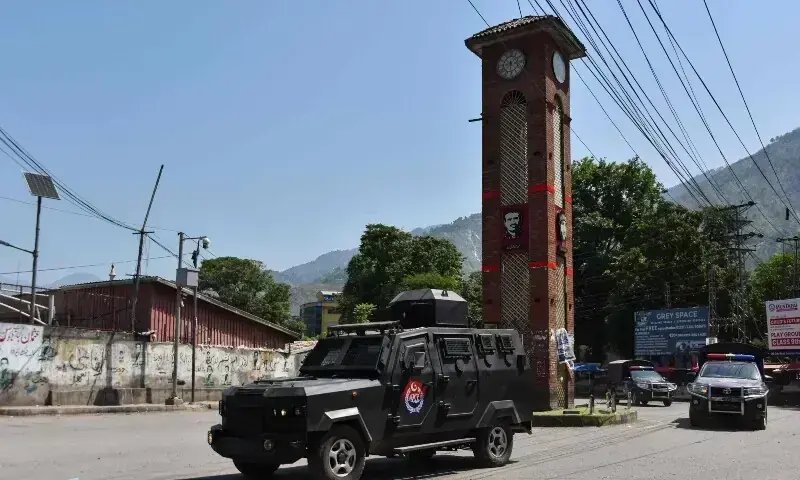
MUZAFFARABAD: The Azad Jammu. Kashmir (AJK) government on Tuesday ruled out any blanket amnesty for leaders of the proscribed Joint Awami Action Committee (JAAC), holding them responsible for recent deaths and violence and vowing to pursue legal action against them.
The regional administration. the JAAC remain at odds over various issues, most notably the committee’s demand to abolish the12 seatsin the region’s Legislative Assembly that are reserved for refugees from Indian-occupied Jammu and Kashmir who settled in mainland Pakistan after 1947.
Addressing a joint press conference alongside Inspector General of Police (IGP) Liaqat Ali Malik, Chief Secretary Khushal Khan said the JAAC leadership had become divided over the ongoing process of negotiations. mediation.
“There will be no blanket amnesty,” he said, adding that the leadership of the proscribed organisation would have to face the consequences of the deaths. violence linked to its movement.
On Tuesday, a strike called by the JAAC continued in various parts of the region, with Muzaffarabad. Poonch divisions observing a partial strike. Meanwhile, most routine activities had resumed in Mirpur.
While some banks across AJK began their operations, connectivity issues persisted as internet services remained suspended. Public transport also remained off the roads in many areas.
At the press conference, Khushal said the government had offered the JAAC several constitutional options to pursue its demand regarding the 12 Legislative Assembly seats reserved for refugees from India-held Kashmir, including an all-parties conference, an assembly session. recourse to the courts.
He claimed that while the government had kept all channels of dialogue open, the organisation had expanded its demands from two points to 38,. then added further demands.
Parliamentary Affairs Minister Tariq Fazal Chaudhryhas maintainedthat 35 out of 38 demands of the JAAC,agreedbetween it. the government last October, had been fulfilled.
During the press conference, the chief secretary said road blockades. violent activities were unacceptable, alleging that highways had been blocked by felling trees and that trucks carrying goods had been stopped and burned in some areas.
He also claimed that an attempt had been made in Rawalakot to hijack trucks carrying relief supplies. which were later recovered by law enforcement agencies.
Khan said maintaining subsidised flour and electricity rates had imposed a heavy financial burden on the government. According to him, reducing electricity tariffs to Rs2.75 per unit could result in annual losses of Rs8 billion to Rs10bn, while subsidies on flour. electricity had required allocations of Rs20bn to Rs25bn from the resources of the federal and AJK governments.
Apparently referring to the considerable number of women. children attending some sit-ins recently, the chief secretary alleged that the JAAC leadership was attempting to use women and children as “human shields”.
The official further alleged that overseas activists linked to the JAAC were raising anti-state slogans.
“Political blackmail has been buried,. the era of peaceful, civilised and logical dialogue has begun,” he said, adding that the government would continue to take constitutional and legal measures to maintain peace and stability.
“Negotiations will never be held at gunpoint.”
Speaking on the occasion, IGP Malik alleged that activists of the proscribed JAAC had opened fire on police during a routine checkpoint inspection on June 5, resulting in the death of one activist. injuries to JAAC leader Umar Nazir and two police personnel.
He claimed that a post-mortem examination of the deceased driver had indicated that he was shot in the back of the neck. suggesting that the fatal bullet had come from inside the vehicle rather than from security forces.
The police chief further alleged that JAAC activists attacked the Rawalakot Combined Military Hospital (CMH), killing three policemen deployed there for security duties. assaulting patients and medical staff.
He said LEAs would continue action against those involved in “anti-state” activities. would uphold the writ of the state at all costs.
Describing the ongoing protest movement, he contended: “This is not a long march but an organised mobilisation.”
The IGP also alleged that women. children were being used as human shields, adding that there were reports of weapons being concealed under burqas. The IGP did not share any additional information supporting the claim.
Moreover, the IGP asserted that those who surrendered unconditionally would be treated fairly under the law.
Meanwhile. AJK Prime Minister Faisal Mumtaz Rathore said reports that the JAAC had approached Jamiat Ulema-i-Islam-Fazl (JUI-F) chief Maulana Fazlur Rehman for mediation vindicated his government’s longstanding insistence on dialogue to resolve the ongoing standoff.
In hisvideo message, Fazl said he has accepted JAAC leaders’ invitation asking him to mediate to resolve the “crisis. tense situation” in AJK.
However. noting that he had been approached at a time when the JAAC wasmullingits future course of action, Fazl said he needed time to convince the government to enter into a dialogue.
Fazl, known for hisengagementwithpoliticiansfrom across the board, urged the JAAC to postpone its sit-in. not intensify its protest so that a pathway for talks can be carved out.
Commenting on the veteran politician’s video, Rathore said the government had from the outset urged JAAC leaders not to abandon negotiations. to return to the table.
“Isn’t this what we’ve been asking from them since Day 1?” he wrote in a post on X, asserting that the group had shown “zero flexibility” despite repeated appeals to end its lockdown. agitation campaign.
“They ignored us,” the AJK premier said.
“Now. after raising slogans against so-called ‘political interference’ in AJK’s affairs, they’ve approached the respected Maulana Fazal-ur-Rehman of JUI, Pakistan, for mediation,” he said.
In a post on Monday, Rathore had expressed concern over hardships faced by residents in areas affected by the ongoing standoff. said he had directed relevant officials to provide immediate relief to the public.
He alleged that videos circulating online showed miscreants threatening and. in some cases, assaulting traders who chose to keep their businesses open.
Rathore stressed that the government had made repeated appeals for “meaningful dialogue”, welcomed third-party mediation efforts. even opened backchannel contacts for negotiations, but claimed that these efforts had failed.
Referring to reports that the JAAC had issued another ultimatum to the government. threatened a march on Muzaffarabad, he warned that any attempt to further aggravate the situation would be dealt with “with full force of law”.
“I assure you all that days of chaos. unrest will soon be behind us, and I’m confident peace and calm will return to our land for good,” he wrote.
On June 9. the day the JAAC was to begin its strike, AJK Prime Minister Faisal Rathore hadcalledfor the issue to be resolved through talks.
As strikesdisruptedroutine life in some parts. Rathore said a week ago that the JAAC bore the “primary responsibility” for pushing the situation to a point where lives were lost. “If they enjoy public support, they should become part of the system and bring reforms from within,” he said.
PPP Chairman Bilawal Bhutto-Zardari, whose party is in power in AJK, has also called for the issue to be resolved in a democratic. peaceful manner.
Ahead of theJuly 27 electionsin AJK. the JAAC had called for widespread protests demanding the abolition of12 seatsin the region’s Legislative Assembly reserved for refugees from occupied Kashmir who settled in mainland Pakistan after 1947.
Elections for these seats are held separately from the 33 general seats in AJK. with refugees registered in 12 constituencies across Pakistan voting for their representatives. The seats have long been politically sensitive due to disputes over voter lists, delimitation, and constitutional amendments.
On June 5, the JAAC was declared aproscribedorganisation by the regional government. placed under the First Schedule of the region’s anti-terrorism act (ATA).
A day later, AJK authoritieslaunched a crackdownon the JAAC, arresting scores of its leaders. laterplacing 147of its activists on the Fourth Schedule of the ATA.
Discussion
Sign in to join the thread, react, and share images.