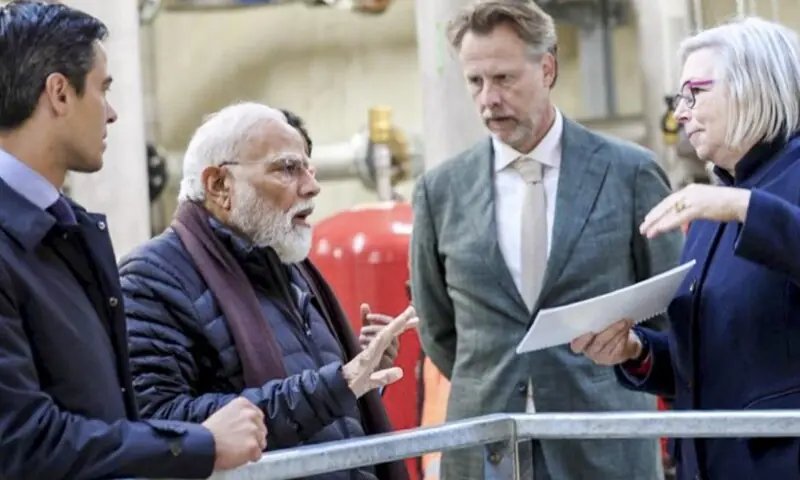
During Indian Prime Minister Narendra Modi’s official visit to the Netherlands. a major controversy erupted during apress briefing in The Hague.
While the official diplomatic objective of the visit was to elevate bilateral ties to a “strategic partnership” — heavily driven by trade, defence,. semiconductor technology — the exchange between Dutch journalists and an Indian diplomat underscored deep friction between Western journalistic standards and the Modi government’s tightly controlled public relations process.
AsThe Wire’sDevirupa Mitra has reported. ahead of the dinner for Modi hosted at Catshuis, the official residence of the Dutch prime minister just outside The Hague, PM Rob Jetten spoke with local reporters. Jetten was asked about aspects of Dutch-India relations.
Jetten told reporters just before Modi arrived that there were concerns among the Netherlands. other EU member states about “developments in India” under Modi’s BJP.
The issue was then forced directly onto the record by Ashwant Nandram. a journalist from the prominent Dutch newspaperDe Volkskrant, who asked the following question to the Indian delegation during the official media briefing:
“I’m a journalist for the Dutch newspaper, De Volkskrant. I have a few questions. In the Netherlands, there is a tradition that after such a visit, both prime ministers are available for questions. I wonder what the reason is that that is not the case today.
Another thing is that today, during a statement of Prime Minister Jetten, he said that the Netherlands. the European Union are worried about, he said, press freedom and minority rights, among them the Muslim community and smaller communities. I wonder what the response is of the Indian government.”
Faced with Nandram’s direct questioning. the MEA’s Secretary (West) Sibi George, deployed an assertive counter-narrative frequently used by the political leadership to neutralise international human rights critiques. The diplomat attempted to frame the journalist’s concerns as personal ignorance, stating:
“We face these kinds of questions basically because of the lack of understanding of the person who asked the question.”
He then pointed to India’s 1.4 billion people, massive voter turnouts,. a “noisy democracy” powered by 900 million smartphones as proof of a thriving civic space. He claimed that India’s minority population had risen from 11 per cent at the time of independence to over 20pc. challenging critics to find another nation with similar growth. His defence invoked a 5,000-year-old pluralistic heritage, highlighting that religions like Christianity, Islam,. Judaism found historical refuge in India without facing institutional persecution.
However, the Indian diplomat’s attempt to dismiss the critique as a “lack of understanding” by a single reporter completely collapsed when Merel Thie from the Dutch newspaperNRCfollowed up to clarify that the concerns were not a product of journalistic bias,. were a direct echo of statements made by the Dutch prime minister.
The resulting back-and-forth captured the exact moment the diplomatic script broke down under persistent questioning:
“My name is Merel Thie and I’m from the Dutch newspaper NRC. And as you were referring to my colleague, he was actually citing our Prime Minister who said he was worried about minorities. press freedom in India. So, does it upset you when our Prime Minister says this?“
To this, Sibi George responded:
“No, I was giving the factual position of that. So that remains to be the factual position. You need to have more understanding of India to appreciate what India is.“
Merel Thie responded:
“So, Prime Minister [Jetten] should have more understanding because it’s not something we say.“
“I haven’t seen that statement. I am referring to the question which, you know, about that topic which was raised about the freedom. I think I have clarified how beautiful a country India is. Thank you.“
By claiming “I haven’t seen. statement,” the Indian diplomat attempted a calculated retreat to avoid a direct diplomatic incident with the host nation. It allowed him to bypass the reality that the prime minister of the Netherlands, the very leader hosting the Indian prime minister, held profound reservations regarding the Modi government’s democratic. human rights record.
The exchange serves as a stark reminder of the yawning gap between New Delhi’s branding. its domestic realities, and the fragility of an apparatus hostile to independent scrutiny.
When forced outside of its tightly engineered media bubble. the Modi government’s inability to provide a substantive defence proves that beneath the assertions of being the “mother of democracy” lies a deep resistance to accountability.
The incident exposed the limits of the Modi government’s standard international defence mechanism when subjected to unscripted journalistic scrutiny from a free press.
Throughout his tenure of over 12 years. PM Modi has consistently avoided press conferences, including open, unscripted bilateral press conferences during foreign state visits, choosing instead to deliver pre-formulated joint statements with host leaders. In democratic systems like the Netherlands. where executive accountability to the media is standard diplomatic protocol, this insulation is viewed by journalists as an active suppression of their democratic right.
In 2023, when the White Houseannouncedthat Modi. then US president Joe Biden will be addressing a joint news conference, a White House official had toldReutersthat this is a “big deal” since Modi is infamous for refusing to take questions from the media in India.
These were thefirst questionsthat Modi had answered in an open press conference sinceNovember 2015 in London.
“India has long prided itself as the world’s largest democracy, but there are many human rights groups who say that your government has discriminated against religious minorities. sought to silence its critics,” a reporter from theWall Street Journaltold Modi,adding, “What steps are you and your government willing to take to improve the rights of Muslims and other minorities in your country and to uphold free speech?”
Modi parried and brought up the constitution instead. But in the days afterwards, reporter Sabrina Siddiqui was targeted with intense online harassment. attacks by Hindutva politicians and supporters, so much so that the Biden administration came out with a strong condemnation of the online abuse.
India is 157th out of 180 countries in the 2026 World Press Freedom Index released by Reporters Without Borders on April 30.
This article was originally published onThe Wireand has been reproduced with permission.
Discussion
Sign in to join the thread, react, and share images.